



TL;DR: AI vs human customer service is about balance. AI drives speed, scalability, and cost efficiency for routine tasks, while humans manage complex, emotional cases. Hybrid models combine AI efficiency and human expertise to optimize outcomes, guided by performance benchmarks to continuously improve efficiency and experience.
Choosing between AI and human customer service is no longer a future decision; it directly impacts your support team’s daily performance.
Human-only models struggle to scale efficiently, while AI-only approaches may fall short in handling complex issues. These gaps lead to slower resolutions, higher costs, and inconsistent experiences.
The most effective approach is a hybrid model, where AI handles repetitive tasks and routing, and human agents focus on complex, high-value interactions.
This guide breaks down how AI and human customer support compare in 2026, using practical benchmarks, trade‑offs, and clear guidance on what to automate and what should remain handled by support agents.
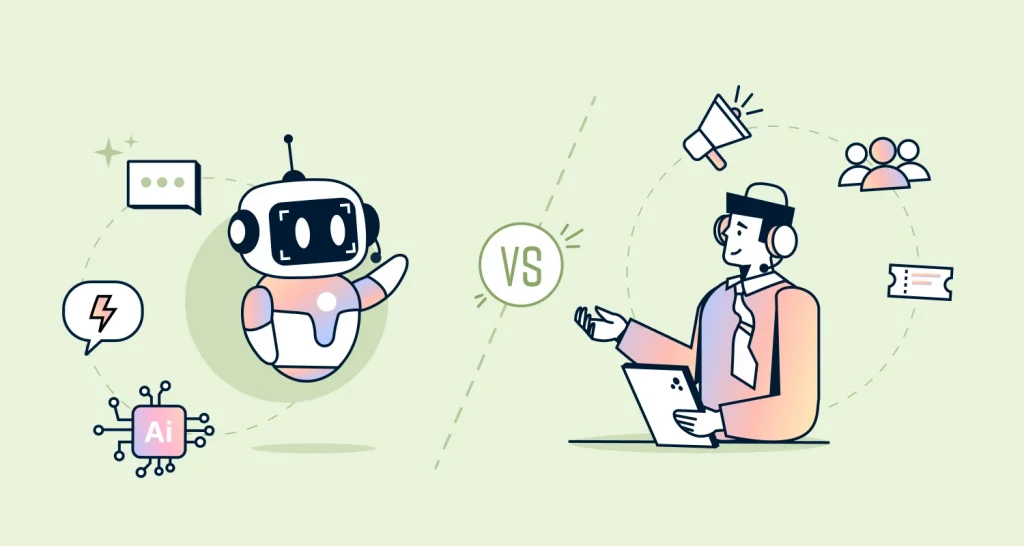
What is the difference between AI and human customer service?
AI customer service is the use of advanced artificial intelligence to resolve customer concerns across channels in a more tailored and efficient way.
It includes systems such as AI agents, AI copilots, and AI‑driven actions that work together to handle interactions, assist human teams, and manage customer service tasks.
AI systems are designed to provide fast, scalable support by managing routine and high-volume requests, offering instant responses, and learning from past interactions to improve over time.
Human customer service, on the other hand, involves assistance provided by trained agents who engage directly with customers to address their issues.
It focuses on handling complex, sensitive, or unique issues that require judgment, critical thinking, and empathy, while also building customer trust through personalized interactions.
AI vs human customer support: Key comparison
Comparing AI and human customer support highlights their distinct capabilities, helping organizations determine how each can be applied across different customer service scenarios as shown below.
| Aspect | AI customer service | Human customer service |
| Speed and response time | Provides near-instant responses | Slower due to queues but improves with experience |
| Availability | Available 24/7, handles many queries at once | Limited by working hours and staffing |
| Empathy and emotional intelligence | Limited empathy, can feel robotic | Strong empathy and human connection |
| Handling routine tasks | Efficient at repetitive and standard tasks | Less efficient for routine tasks, better for complex ones |
| Complexity handling | Can struggle with complex or sensitive issues | Strong at complex, high-stakes situations |
| Personalization | Data-driven personalization | Context-rich, human-driven personalization |
| Cost efficiency | Lower cost and highly scalable | Higher cost, depends on workforce |
| Customer preference | Preferred for speed and convenience | Preferred for quality and trust |
AI vs human customer service: Where each excels and performance benchmarks
Both AI and human customer service bring distinct strengths to the support experience, shaping how businesses balance efficiency with customer satisfaction.
Understanding where automation excels and where human interaction is essential helps organizations design smarter, more effective support strategies.
To break this down, let’s explore how both compare across performance, capability, and real-world impact.
Where AI customer service works best
AI is widely used to handle customer interactions at scale, using automation to manage high volumes of support requests efficiently across channels.
It excels in the following areas:
- Speed and availability: AI customer service delivers near-instant responses, typically 3-5 seconds for chat and seconds on calls (Turing). It also offers 24/7 support with zero downtime, handling thousands of interactions simultaneously and eliminating wait times, even during peak demand.
- Consistency: AI manages routine customer interactions with consistent, policy-aligned responses, reducing variability. With intent recognition accuracy reaching up to 94% (IJSAT), it delivers more precise support and minimizes inconsistencies commonly seen in human responses.
- Cost efficiency: Automation can deflect up to 25% of support tickets, saving $0.50-$1.50 per interaction (Worldmetrics). At scale, these savings compound, making AI not just faster, but cost-effective for customer support operations.
- Ticket routing: Customer service reports by All About AI indicate that AI-driven ticket routing achieves accuracy rates of up to 89% for technical issues, improving ticket assignment by directing issues to the right teams from the start, reducing manual triage, and speeding up overall resolution times.
Where human customer support still matters
While AI brings speed and efficiency, human support remains essential in situations that require judgment, empathy, and flexibility.
According to Salesforce, 84% of customers say being treated like a person rather than a number is key to earning customer trust, reinforcing the need for human support.
Human agents perform best in the following areas:
- Managing complex or sensitive issues: Human agents apply judgment, think critically, and consider context to deliver clear, well-reasoned decisions tailored to sensitive situations. 84% of customers believe human agents are more accurate and transparent in managing complex and high-stakes interactions (SurveyMonkey).
- Empathy and emotional intelligence: Human agents build trust by actively listening to customers, understanding how they feel, and responding with reassurance. A New Five9 study finds 75% of consumers prefer talking to a human agent, emphasizing the value of emotional connection in support experiences.
- Strengthening long-term customer relationships: Human agents foster loyalty by building genuine connections with customers while taking the time to understand their needs. A Redpoint study shows that 74% of consumers believe brand loyalty is driven by feeling understood and valued, not by discounts or perks.
- High-value retention: Human agents retain customers during critical moments through responsive support and providing clear guidance. 88% of customers say good service increases their likelihood to repurchase (Salesforce), highlighting its impact on reducing churn.
The value of a hybrid customer service model
Delivering great customer support comes from balancing automation and human support.
A hybrid approach is now standard, with 76% of leaders defining a structure where AI supports routing and continuous availability, while human agents take on complex and emotionally sensitive cases (CMSWIRE).
Let’s explore how a hybrid customer service model delivers value.
Seamless AI-to-human handoffs
AI enhances efficiency by performing initial triage, including sorting and prioritizing requests, so support agents receive the right information at the right time.
It should hand off interactions when complexity increases, when emotional sensitivity is detected, or when issues require human judgment and contextual understanding.
Continuous learning and feedback loop
A hybrid model improves over time by combining AI and human expertise. AI manages initial interactions, while human agents step in for complex issues.
Every interaction generates valuable data that continuously enhances system accuracy and improves its ability to understand customer intent.
Example
A customer reports a paid order still showing as “processing.” AI misclassifies it as a delivery delay and gives generic advice. A human agent later identifies it as a payment issue and resolves it correctly.
The correction can then be reviewed and used to improve future AI routing, intent detection, or knowledge base recommendations.
Efficiency with a seamless customer experience
A hybrid customer service model combines AI speed with human understanding to deliver both efficiency and quality. AI handles routine tasks and provides quick responses, while human agents step in for more complex issues, supported by shared customer data for full context.
This ensures fast, consistent support without losing context or continuity, creating a smooth and cohesive journey end-to-end.
Measuring success in a hybrid customer service model
Evaluating performance in a hybrid customer service model requires looking beyond isolated metrics to understand how AI and human agents work together across the full customer journey.
Let’s break it down with real-world benchmarks and practical insights.
First Response Time (FRT)
A strong hybrid setup keeps AI responses instant while making sure handovers to human agents stay smooth.
If response times are inconsistent, it usually means the transition between AI and humans isn’t working well, which can hurt the customer experience.
Benchmark
| Support type | Avg FRT |
|---|---|
| AI (Bots or copilots) | Instant (1–3 seconds) (Chatsy) |
| Human agents | Under 2 minutes (chat), 2–4 hours (email) (StealthAgents) |
Average Handle Time (AHT)
A balanced approach keeps average handle time low by allowing AI to manage repetitive tasks and assist with routine interactions, while human agents focus on resolving sensitive issues.
If AHT is high, it often indicates inefficient workflows or agents spending time gathering information instead of resolving customer issues, which can reduce overall support efficiency.
Benchmark
| Support type | Avg resolution time |
|---|---|
| AI-only | Reduces AHT by 30-50% (Worldmetrics) |
| Human-only | 4-7 minutes (Voice) (Lorikeet) |
First Contact Resolution (FCR)
A hybrid setup ensures most issues are resolved correctly on the first interaction by combining AI’s routing accuracy with human judgment for complex cases.
If FCR is low, it often signals poor intent detection or misrouted escalations, leading to repeated touchpoints and customer frustration.
Benchmark
| Support type | Avg FCR rate |
|---|---|
| AI-only | Above 70% (Plivo) |
| Human-only | 70–79% (SQM Group) |
Customer satisfaction score
A well-balanced hybrid model maintains high satisfaction by pairing AI’s speed with human empathy at the right moments.
If CSAT drops, it typically indicates gaps in handoffs, lack of personalization, or over-reliance on automation in situations that require human understanding.
Benchmark
| Support type | Avg CSAT score |
|---|---|
| AI-only | 85% (Fullview) |
| Human-only | 91% (Phone support) (Fullview) |
Cost per ticket
An effective hybrid approach keeps costs low by allowing AI to handle high-volume, repetitive queries while reserving human agents for high-value interactions.
If costs remain high, it suggests underutilized automation or inefficient allocation of human effort toward tasks that AI could manage.
Benchmark
| Support type | Cost per interaction |
|---|---|
| AI-only | Self-service systems $0.10 (NiceinContact) |
| Human-only | Phone, chat and email $8.01 (NiceinContact) |
Together, these metrics show how hybrid support improves efficiency, scalability, and customer experience.
Best practices for integrating AI and human support
Building an effective hybrid support model requires more than just adding automation.
The following best practices help organizations design how AI and human agents work together while balancing efficiency and empathy across the entire customer experience.
Map the customer journey before automating
Organizations often automate support without fully understanding customer friction. Map the full journey from onboarding to cancellation.
At each stage, identify customer goals, emotions, and support needs. Use AI for routine tasks while reserving humans for sensitive interactions. Keep journey maps updated with ongoing feedback.
Outcome: Smarter automation, less frustration, and better use of resources.
Align support with customer and issue complexity
Not every interaction needs the same level of support.
Segment requests by complexity. Use automation for simple tasks, AI with escalation for moderate queries, and human agents for complex issues. This ensures each interaction is handled appropriately without delays.
Outcome: Faster resolutions, efficient resource use, and a more personalized experience.
Use data to continuously improve AI-human collaboration
Effective hybrid customer service models continuously improve through data-driven optimization.
Track key metrics across AI and human interactions, then identify patterns that reveal gaps. Use insights to refine workflows, enable AI to assist agents with summaries, and let agents improve AI through feedback and corrections.
Outcome: Fewer misrouted tickets, faster resolutions, and continuously improving AI performance.
Establish clear escalation paths
Define clear triggers for escalation, such as failed intents, negative sentiment, or sensitive requests.
Use tiered routing to direct issues appropriately, and provide support agents with conversation context during handoff while informing customers of next steps. This helps maintain continuity and avoid repetition.
Outcome: Faster resolutions, less frustration, and increased customer confidence.
Focus on customer intent, not support channels
Customers expect consistent support across all support channels. Prioritize understanding and resolving customer intent over channel optimization.
Use AI to identify needs and route requests within a unified system backed by shared knowledge and customer data. This helps maintain consistency and reduce unnecessary transfers.
Outcome: More consistent experiences and fewer channel-related gaps.
Introduce AI gradually and scale based on results
Many AI initiatives fail by trying to automate too much too quickly.
Start with targeted use cases, measure results, and expand based on performance. Use pilots to identify where AI adds value and where human support is needed, then scale accordingly.
Outcome: Lower risk, higher adoption, and a scalable, sustainable support model.
How BoldDesk balances AI and human customer service
BoldDesk combines AI capabilities with human expertise to help teams deliver efficient, high-quality support at scale.
Instead of replacing agents, AI is used to enhance their productivity and improve response quality in the following ways:
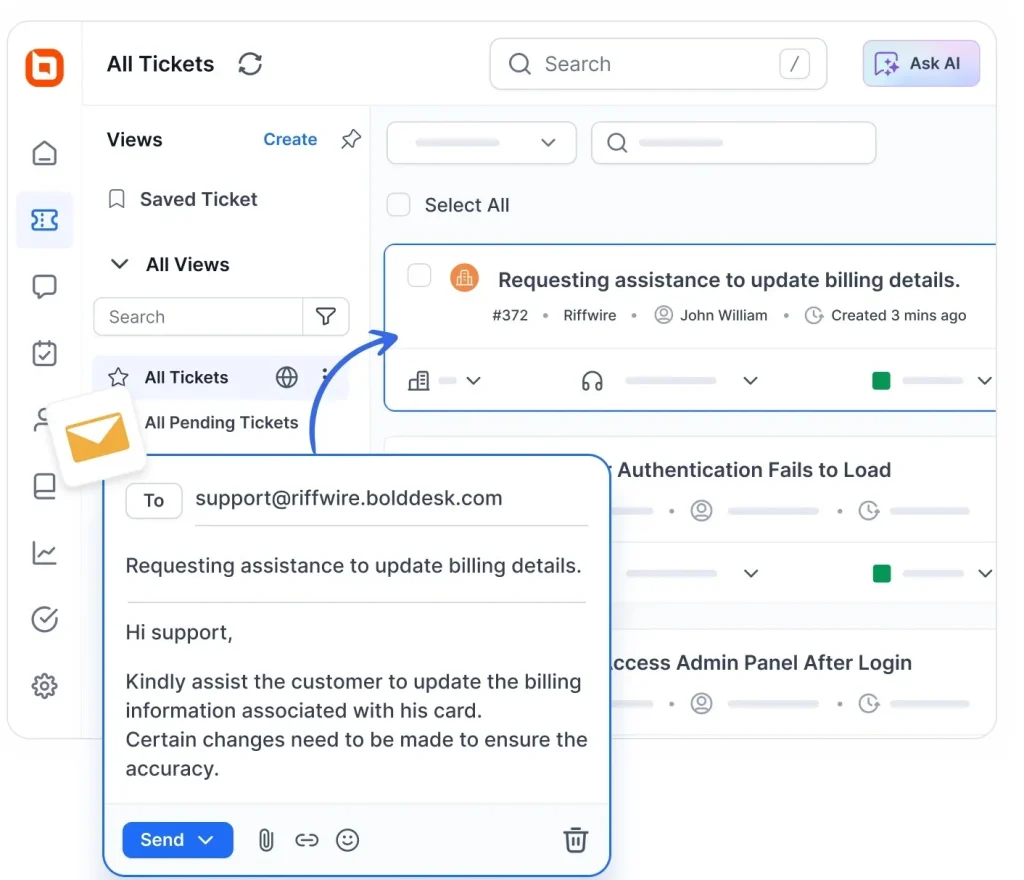
- AI-driven automation of routine tasks: AI Actions handle routine tasks like tagging, routing, and updates to ensure fast, consistent resolutions, while human agents step in for approvals or judgment to maintain control and a seamless experience.
- Smart collaboration between AI and human agents: AI Copilot helps agents with suggestions, summaries, and knowledge insights, enabling faster, more accurate resolutions while keeping humans in control.
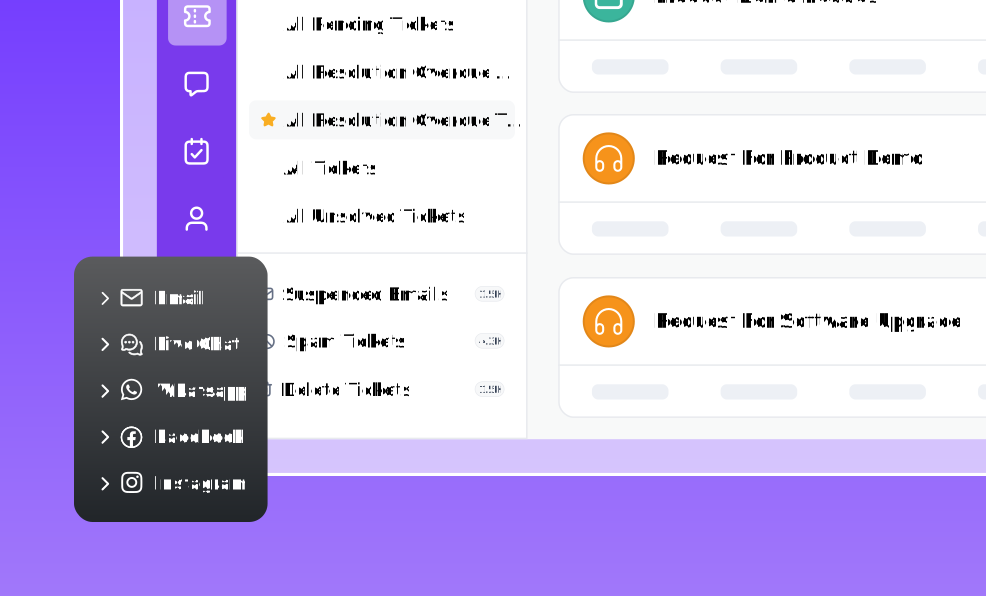
- Seamless AI-to-human handoffs: When issues require human attention, BoldDesk ensures a smooth transition from AI to agents across omnichannel interactions, with full context preserved so customers do not have to repeat themselves.
- Continuous optimization through data: By leveraging reports and analytics to evaluate performance across both AI and human interactions, BoldDesk helps teams refine workflows, improve routing accuracy, and enhance the overall customer experience.
Strike the right balance between AI and human customer service
AI and human support should not compete for the same role. AI is strongest when it handles speed, scale, routing, and repetitive tasks. Human agents are most valuable when customers need judgment, empathy, reassurance, or complex problem-solving.
With a hybrid customer service model, teams can reduce repetitive workload, improve response speed, preserve service quality, and control support costs.
With platforms like BoldDesk, teams can unify workflows, automate tasks, and clearly define roles across AI and human support.
The result: higher customer satisfaction and lower costs.
Ready to reduce support costs and improve CSAT with a hybrid customer service model? Start a 15-day free trial or book a live demo today. Contact our support team for assistance.
Was this blog helpful? Please let us know in the comments section below.
Related articles
- How to Build AI Agents with BoldDesk for Smarter Support
- AI-Powered Customer Support: Tips for Scalable Business Growth
- How Agentic AI Is Transforming Customer Experience in 2026
FAQs
No. AI is increasingly handling high‑volume, routine interactions, but human customer support remains essential for complex, emotional, and high‑risk issues. The most effective teams use a hybrid model, where AI supports agents rather than replacing them.
AI improves customer support by enabling instant, 24/7 responses, handling high volumes of repetitive queries at scale, reducing costs per interaction, and freeing human agents to focus on complex, high-value issues.
AI can struggle with understanding emotional nuance, complex problem‑solving, and edge cases that require judgment or flexibility. It may also misinterpret context, leading to inaccurate or frustrating responses without proper oversight or escalation to human agents.
Issues involving judgment, empathy, policy exceptions, or revenue risk should be handled by human agents. These scenarios benefit from contextual understanding that AI customer service still struggles to replicate consistently.
Businesses should measure AI customer service and human support using shared KPIs such as CSAT, FCR, AHT, escalation rate, and cost per ticket, while evaluating handoff quality to ensure issues are routed and resolved efficiently. Clear reporting helps identify where AI adds value and where human support performs better.