
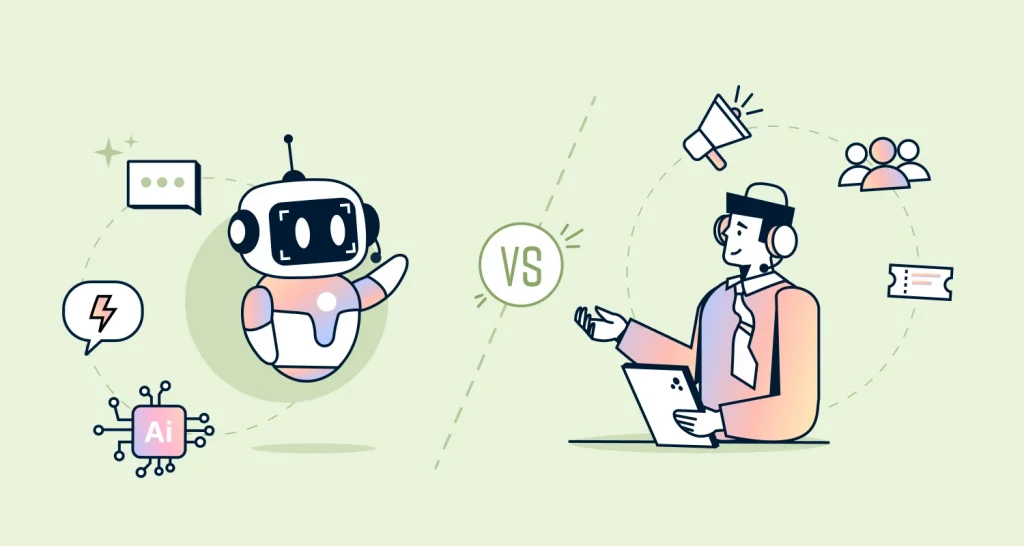



TL;DR: AI vs. human customer service is about balance. AI drives speed, scalability, and cost efficiency for routine tasks, while humans manage complex, emotional cases. Hybrid models combine AI efficiency and human guidance to deliver faster support, better customer experiences, and more effective outcomes.
Customer support teams face growing pressure as ticket volumes increase and customers expect faster responses. To keep up, businesses are turning to AI-powered support to automate repetitive requests and improve efficiency.
However, AI is not a perfect solution. Customers can become frustrated when AI agents fail to understand complex issues, lack empathy, or make it difficult to reach a human agent.
This raises an important question: When should businesses use AI, and when is human support the better choice?
This guide compares AI and human customer service in 2026, helping you determine when to use AI, when to rely on human agents, and how to build a hybrid support model that improves both efficiency and customer satisfaction.
AI vs. human customer support: Where each excels and fails
AI and human support each bring distinct strengths to the customer journey, helping businesses balance efficiency, scalability, and customer satisfaction.
Understanding where each performs best and where each has limitations enables organizations to build a support strategy that delivers both operational efficiency and high-quality service experiences.
When AI works best in customer service
AI delivers the greatest value when customer interactions are predictable, repetitive, and time sensitive.
It automates routine support tasks, enabling businesses to respond faster, reduce operational costs, and enhance productivity.
AI support excels in the following areas:
- Speed and availability: Customers can access support without delays, as AI processes requests instantly and remains continuously available, ensuring consistent service even during peak periods.
- Consistency: With AI providing standardized responses, interactions remain aligned with policies and maintain a consistent level of quality across customer support operations.
- Cost efficiency: By automating repetitive and high-volume queries, AI lowers operational costs and allows support teams to scale without proportionally increasing resources.
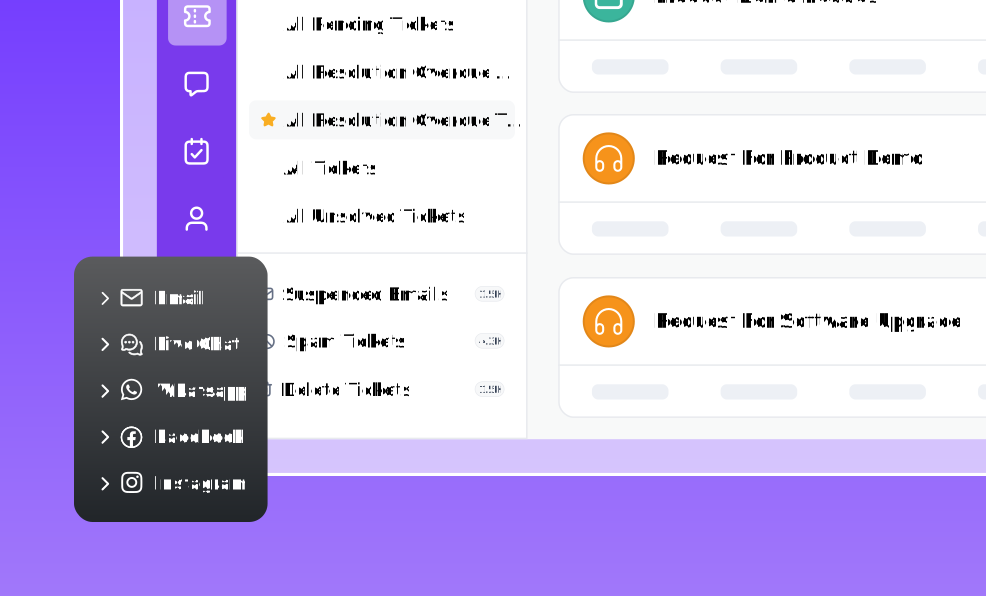
- Ticket routing: Automated ticket routing reduces manual triage, shortens response times, and helps support teams meet SLA targets by ensuring tickets reach the right agent the first time.
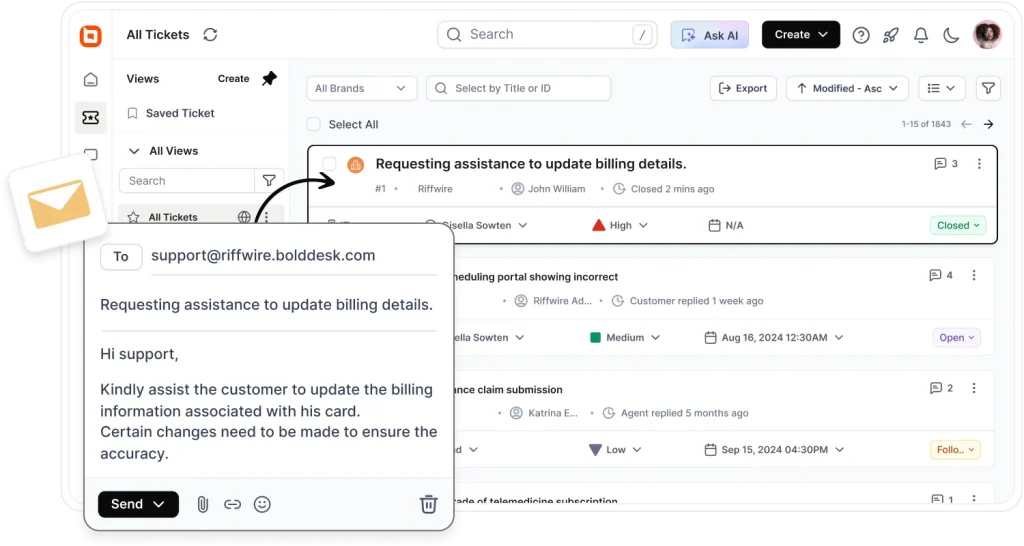
As AI capabilities continue to evolve, innovations such as Agentic AI in customer experience are enabling support systems to take more proactive actions, optimize workflows, and deliver more personalized customer interactions at scale.
Where AI fails in customer support
Although AI improves efficiency and scalability, it is not suited to every customer interaction. AI still struggles when conversations require emotional intelligence, contextual reasoning, or flexible decision-making.
AI customer service is less effective when:
- Customers need reassurance: While AI can recognize intent and customer sentiment, it cannot respond with genuine empathy or adapt its communication to emotional situations. Complaints and service failures often require human interaction to rebuild confidence and trust.
- Issues require investigation or judgment: AI works best with structured information and predefined workflows, but complex troubleshooting, billing disputes, and policy exceptions often require human reasoning, analysis, and decision-making.
- Situations fall outside existing knowledge: AI relies on the quality and completeness of available data. When customer requests are unusual or information is missing, it may struggle to provide accurate, context-aware responses.
Example: A customer requesting a refund because of a unique billing error may require an agent to investigate account history, review company policies, and determine whether an exception should be made based on the specific circumstances.
When human agents matter in customer service
Human agents continue to play an essential role in customer service because they combine technical expertise with empathy, critical thinking, and adaptability.
While many are comfortable using AI for quick, routine tasks, 79% still prefer talking to a human agent, and 84% believe humans provide more accurate answers, according to SurveyMonkey research.
Human agents perform best in the following areas:
- Complex or unclear issues: Human agents excel when customers present problems that require investigation, troubleshooting, or judgment beyond predefined workflows. Examples include software bugs, unusual account issues, and cross-department support requests.
- Emotionally sensitive conversations: Refund disputes, service disruptions, customer complaints, and negative experiences often require empathy and reassurance that AI cannot consistently provide.
- Billing, legal, or compliance-related issues: Financial disputes, privacy concerns, contractual obligations, and regulated interactions require accountability and careful decision-making.
- High-value or at-risk customers: When a customer relationship has significant revenue impact or churn risk, personalized engagement can preserve trust and strengthen long-term customer loyalty.
Where human agents fail in customer support
While human support provides empathy and judgment, relying solely on human agents also presents operational challenges, particularly as customer expectations and ticket volumes continue to grow.
Human support is less effective when:
- Large volumes of repetitive requests need immediate responses: Password resets, appointment scheduling, and frequently asked questions consume valuable agent time despite requiring little judgment.
- Businesses need 24/7 availability: Unlike AI, human agents operate within scheduled working hours, making around-the-clock support difficult without larger teams or global staffing models.
- Support demand fluctuates unexpectedly: Seasonal peaks, product launches, and service outages often require additional hiring, onboarding, and training, increasing operational costs and reducing flexibility.
Rather than replacing human expertise, AI helps eliminate repetitive work so agents can focus on conversations where their knowledge, empathy, and decision-making create the greatest value.
Together, AI and human agents enable organizations to deliver faster, more scalable, and more customer-centric support experiences.
AI vs. human customer support: A side-by-side comparison
AI customer service uses artificial intelligence, including AI agents, copilots, and automated actions, to answer questions, route requests, assist support teams, and resolve routine customer issues.
Human customer service, on the other hand, involves assistance provided by trained agents who engage directly with customers to address their issues, helping businesses build customer trust.
Comparing AI vs. human support highlights their distinct capabilities, helping organizations determine how each can be applied across different customer service scenarios, as shown below.
| Aspect | AI customer service | Human customer service |
| Speed and response time | Provides near-instant responses | Slower due to queues but improves with experience |
| Availability | Available 24/7, handles many queries at once | Limited by working hours and staffing |
| Empathy and emotional intelligence | Limited empathy, can feel robotic | Strong empathy and human connection |
| Complexity handling | Can struggle with complex or sensitive issues | Strong at handling complex, high-stakes situations |
| Personalization | Data-driven personalization | Context-rich, human-driven personalization |
| Cost efficiency | Lower cost per interaction once deployed | Higher cost, depends on workforce |
| Scalability | Scales instantly to support increasing ticket volumes | Requires additional hiring and training to scale |
| Customer preference | Preferred for speed and convenience | Preferred for quality and trust |
| Use case fit | Best for FAQs, password resets, order tracking, and account updates | Best for escalations, billing disputes, and customer complaints |
The comparison reveals that AI and human agents excel in different areas of customer service. Rather than viewing AI and humans as competing approaches, businesses should evaluate each customer interaction and use the option best suited to the task.
Choosing between AI vs. human customer service
There isn’t a single customer support model that works for every organization. The right approach depends on your customer expectations, support volume, issue complexity, and operational goals.
AI is the better choice for repetitive, high-volume interactions that require speed and consistency. Human agents remain essential for situations involving critical thinking, negotiation, or complex decision-making.
A hybrid approach is becoming the preferred model for many support teams, with 76% of leaders defining a structure where AI supports routing and continuous availability, while human agents take on complex and emotionally sensitive cases (CMSWIRE).
Use the following decision framework to identify whether AI, human agents, or a hybrid approach is best suited for each support scenario.
| Customer issue | Best approach | Reason this approach is recommended |
| Password reset | AI | Simple, repetitive request that requires speed rather than human judgment |
| Order status inquiry | AI | Information is readily available and can be delivered instantly |
| Appointment scheduling | AI | Rule-based workflow with minimal complexity |
| Billing dispute | Human | Requires investigation, judgment, and customer reassurance |
| Account cancellation requests | Human | Retention opportunities and customer concerns often require personal engagement |
| Legal or compliance-related inquiry | Human | Sensitive issues require careful review and accountability |
| Frustrated or emotional customer complaint | Human | Empathy and customer reassurance are critical to resolution |
| Complex product configuration issue | Hybrid | AI gathers information first, then routes to a specialist with context |
| High-value or enterprise customer request | Hybrid | AI speeds up intake while human agents manage the relationship |
The most effective customer service strategies do not rely on AI or human agents alone. Instead, they use each where they add the most value, combining AI’s efficiency with human expertise to deliver improved service outcomes.
How BoldDesk helps teams build a balanced AI-human support model
For support teams, the challenge is not choosing between AI and human agents. It is creating a workflow where routine tasks are automated, escalations are well defined, and agents have the context needed to resolve issues confidently.
BoldDesk helps teams automate repetitive work with AI while ensuring human agents remain focused on complex, sensitive, and high-value customer conversations.
Instead of replacing agents, AI customer service is used to enhance their productivity and improve response quality in the following ways:
- Automates routine requests with AI agents: Handles FAQs, order updates, ticket categorization, and repetitive customer inquiries automatically.
- Assists agents with AI Copilot summaries and replies: Provides human agents with conversation summaries, suggested responses, and contextual recommendations.
- Escalates complex issues with full context: Transfers conversations seamlessly from AI to human agents while preserving ticket history and customer information.
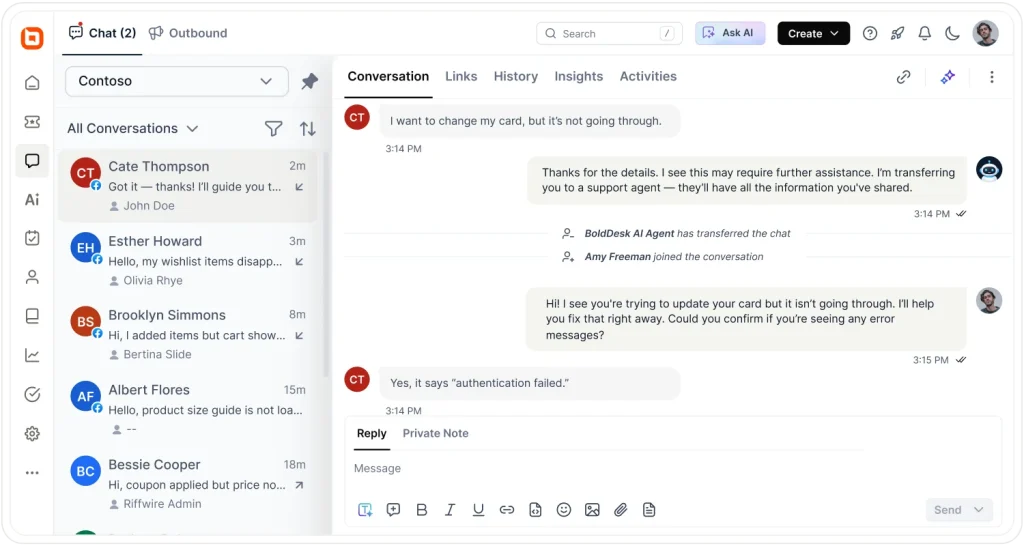
- Tracks performance with reports and analytics: Measures AHT, FCR, CSAT, cost per ticket, and escalation rates to continuously improve operations.
By combining autonomous AI agents with human expertise, BoldDesk enables support teams to scale efficiently while delivering personalized, high-quality support.
Drive better customer outcomes with a balanced AI and human support model
AI and human customer service aren’t competing solutions. They solve different customer needs. Businesses that align each approach with the right type of interaction can improve efficiency without compromising customer experience.
Instead of replacing human agents, AI allows them to focus on the conversations where human expertise has the greatest impact.
Platforms like BoldDesk help teams scale support operations while maintaining a consistent and personalized customer experience.
Want to reduce repetitive support work without losing human control? Start a 15-day free trial or book a BoldDesk live demo to see how AI and human agents can work together.
If you’d like extra guidance, contact our support team, which is dedicated to helping you succeed.
Was this blog helpful? Please let us know in the comments section below.
Related articles
- How to Build AI Agents with BoldDesk for Smarter Support
- AI-Powered Customer Support: Tips for Scalable Business Growth
- How Agentic AI Is Transforming Customer Experience in 2026
FAQs
No. AI is increasingly handling high‑volume, routine interactions, but human customer support remains essential for complex, emotional, and high‑risk issues.
The most effective teams use a hybrid model, where AI supports agents rather than replacing them.
AI improves customer support by enabling instant, 24/7 responses, handling high volumes of repetitive queries at scale, reducing costs per interaction, and freeing human agents to focus on complex, high-value issues.
Customer preference depends on the situation. In most cases, customers prefer AI for speed but humans for quality and trust.
This shows that AI is effective for efficiency, but human support remains essential for complex or high-stakes interactions.
Issues involving judgment, empathy, policy exceptions, or revenue risk should be handled by human agents.
These scenarios benefit from contextual understanding that AI still struggles to replicate consistently.
Businesses should measure AI and human support using shared KPIs such as CSAT, FCR, AHT, escalation rate, and cost per ticket, while evaluating handoff quality to ensure issues are routed and resolved efficiently.
Clear reporting helps identify where AI adds value and where human support performs better.