

 In this page
  In this page

TL; DR: AI support can fail due to bad data, poor context, and too much automation. To fix this, businesses need fresh data, smart workflows, and human backup. Tools like BoldDesk help balance AI and support agents to deliver fast, helpful, and reliable customer support.
If your support is getting faster but customer frustration is growing, your AI might be creating problems instead of solving them.
As businesses race to deliver faster, always‑on service, automated systems are becoming a core part of modern customer support strategies. AI now handles instant replies, ticket triage, and repetitive FAQs.
In theory, this promises efficiency and scale. Yet as adoption grows, AI customer support challenges are getting harder to ignore.
AI often misinterprets intent, misses context, and struggles with complex or emotional interactions. The result? Frustrated customers, higher escalations, and declining trust.
According to Salesforce, only 33% of AI initiatives are meeting ROI targets. Even more concerning: 72% have failed to scale across business units, and 20% have stalled, failed outright, or been abandoned.
This gap between promise and performance highlights a growing challenge: deploying AI in customer support is easy, but deploying it effectively is not.
In this article, we’ll explore the most common AI customer support challenges, explain why they persist, proven fixes to address them, and show how BoldDesk helps organizations overcome these challenges and scale AI‑driven support successfully.
What are the biggest AI customer support challenges?
AI customer support problems are recurring failures in automated support systems caused by poor data quality, missing context, excessive automation, limited emotional intelligence, and weak escalation paths to human agents.
Here are the most common AI customer service limitations:
- Understanding user intent: Customer questions may be misinterpreted when language is vague, informal, emotional, or shaped by cultural context.
- Lack of empathy and emotional intelligence: Responses can be factually correct yet fail to recognize frustration, urgency, or emotional cues.
- Poor escalation to human agents: Failing to hand off smoothly when AI reaches its limits can frustrate customers.
- Bias and fairness issues: Outputs may unintentionally mirror biases fixed in training data, leading to unfair or uneven outcomes.
- Data privacy and security concerns: Handling sensitive customer data requires strict safeguards that AI systems may complicate.
- Handling complex or unusual issues: Nonstandard, multi‑step, or highly technical problems often exceed AI’s capabilities.
- Lack of transparency and explainability: Decisions or responses are often difficult to interpret, making it hard to justify outcomes to customers or debug errors internally.
- Model drift and maintenance challenges: Performance degrades as data, products, or policies change, requiring continuous monitoring, retraining, and validation.
Example: A telecom’s AI chat widget, launched to cut call volume, frustrates customers by sending them into repetitive troubleshooting loops and ignoring prior inputs.
Common reasons behind AI customer support failures
AI customer support systems promise efficiency and scale, but they often fall short when critical foundations are missing.
Here are the most common reasons they fail:

Poor or outdated training data
AI systems are only as good as the data they’re trained on. When training data is outdated, incomplete, or biased, the AI delivers inaccurate or irrelevant responses.
You’ll often see this when AI suggests outdated policies, incorrect pricing, or solutions that no longer apply.
Without continuous data updates, AI quickly falls behind customer expectations and current business realities.
Lack of context awareness
Many AI support tools struggle to understand context across a conversation. They may treat every message as a new interaction, ignoring previous questions, customer history, or prior frustrations.
As a result, customers are asked to repeat themselves, and conversations feel robotic rather than helpful. Context gaps break trust and make even simple issues feel unnecessarily difficult.
Over-automation without human oversight
Relying too heavily on automation can backfire when there’s no clear path to human support. While AI is excellent for handling routine tasks, not every query can or should be automated.
When businesses remove human oversight entirely, customers are forced to repeat themselves, escalations fail, and critical issues go unresolved, creating frustration instead of efficiency.
Incorrect workflow or intent setup
AI models depend on properly defined workflows and intents to route conversations correctly. When these are poorly designed, the AI misunderstands what customers are trying to do.
A billing issue may be treated as a technical problem, or a cancellation request may never reach the right team.
These setup mistakes disrupt the customer journey and increase resolution time.
No quality monitoring
Once AI is deployed, many teams assume it will “just work.” Without ongoing monitoring and performance reviews, errors go unnoticed and poor responses continue indefinitely.
Quality monitoring like reviewing conversations and tracking resolution success is essential to identify gaps, retrain the AI, and improve accuracy over time.
Inability to handle complex or emotional issues
Difficulties arise when conversations involve emotion, urgency, or complex issues.
Angry, confused, or distressed customers often need empathy and human judgment, something AI cannot fully replicate yet.
When AI responds with scripted or overly neutral language in emotionally charged situations, it can escalate frustration and damage customer relationships.
Poor integration with support systems
When AI doesn’t integrate smoothly with customer databases, CRMs, or ticketing systems, it operates blindly. It may not recognize returning customers, past tickets, or ongoing issues.
This lack of integration creates disjointed customer experiences and forces customers to re-explain their queries, defeating the purpose of intelligent automation.
No clear AI guardrails or governance
When AI customer support systems access unverified data or are allowed to take risky actions, the consequences can be serious.
Without strict controls on data sources and decision boundaries, AI may pull outdated, incorrect, or unauthorized information and use it to respond to customers.
This can result in answers that contradict company policies, local regulations, or even previous support interactions.

7 Proven ways to fix AI customer support problems
Once the root causes of AI customer service limitations are clear, the next step is addressing them systematically.
Below are 7 proven strategies that help AI systems deliver faster, more accurate, and more human-like support experiences.
1. Improve and refresh training data
AI plays a critical role in customer support by delivering fast, accurate, and consistent responses, but its effectiveness depends entirely on the quality and freshness of the data it learns from.
Well-maintained training data allows AI to reflect real policies, real products, and real customer language.
What to do:
- Regularly update knowledge bases with current policies, pricing, and product changes so AI responses remain accurate and trustworthy.
- Train AI using real customer conversations, not just ideal FAQs, to capture how customers describe problems and ask questions.
- Remove duplicate, outdated, or conflicting content to prevent confusion and reduce incorrect or inconsistent answers.
When training data is clean, current, and grounded in real customer interactions, AI becomes a reliable frontline support tool.
2. Maintain omnichannel consistency
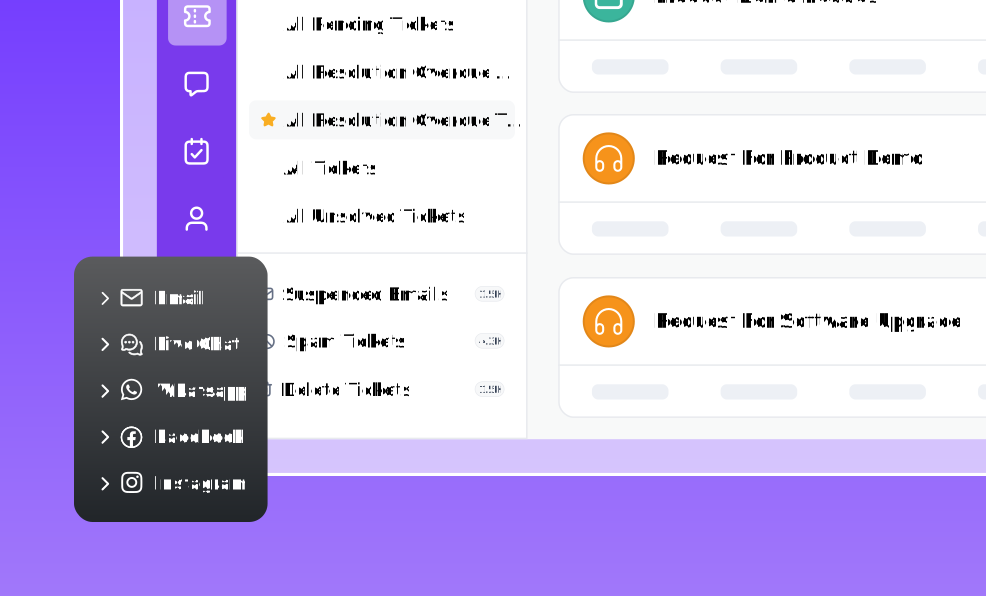
Customers don’t see channels; they see one conversation. Whether they reach out via email, live chat, WhatsApp, or social media, they expect the same level of accuracy, tone, and responsiveness.
AI helps maintain this consistency by unifying conversations across channels and giving support teams a single, complete view of the customer.
What to do:
- Centralize all customer interactions into one shared view so agents and AI have full context, regardless of where the conversation started.
- Apply consistent intent detection, knowledge sources, and response guidelines across channels to ensure customers receive the same answers everywhere.
- Use AI to track conversation history and customer context across touchpoints, preventing repeated questions and fragmented experiences.
By maintaining omnichannel consistency, AI reduces confusion, eliminates duplicated effort, and ensures customers receive a seamless support experience.

3. Balance automation with personalization
AI can significantly improve customer support efficiency, but too much automation can make interactions feel cold and frustrating.
The goal is to use AI to enhance responsiveness and relevance while ensuring customers still feel understood and supported as individuals.
What to do:
- Use AI for repetitive, low‑risk tasks such as FAQs, order status checks, password resets, and basic troubleshooting, freeing human agents to focus on complex or emotional issues.
- Leverage customer history and preferences so automated responses feel personalized, contextual, and relevant rather than scripted or generic.
- Offer a clear and easy path to human support when issues become complex, sensitive, or when customers explicitly request it.
By balancing automation with personalization, AI improves support operations without sacrificing the human touch.
4. Use intent detection to route conversations smartly
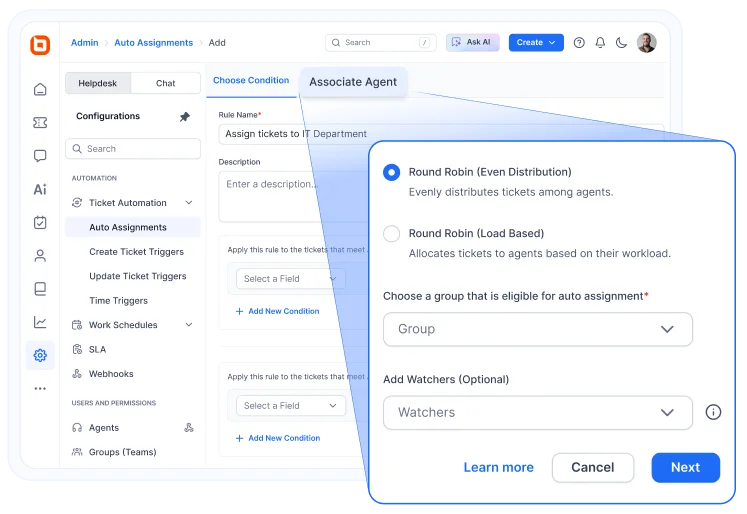
Intent detection enables AI to understand why a customer is reaching out, such as billing, technical support, or sales, and automatically route the conversation to the right team or workflow.
When intent is accurately identified, triage is faster, handoffs are reduced, and resolutions happen more efficiently.
What to do:
- Review and refine intent definitions regularly to reflect how customers describe their issues and requests.
- Test workflows using real customer scenarios to uncover overlaps, gaps, and edge cases that may cause misrouting.
- Add intelligent escalation paths when intent is unclear, allowing AI to ask clarifying questions or route to a general queue instead of forcing a wrong classification.
Accurate intent detection keeps conversations on track, prevents unnecessary escalations, and significantly reduces resolution time.
5. Monitor performance with actionable insights
AI delivers real value in customer support only when its performance is actively monitored and continuously improved.
Tracking the right metrics helps teams spot issues early, optimize workflows, and ensure AI enhances outcomes instead of creating hidden inefficiencies.
What to do:
- Track key metrics like response accuracy, resolution time, and CSAT to understand how AI impacts customer experience efficiency.
- Monitor backup responses and human handovers to identify where AI lacks confidence or clarity.
- Retrain AI models regularly to help the system adapt to new customer needs and behavior.
Continuous monitoring turns AI into a learning system rather than a static tool. With clear visibility and data‑driven adjustments, AI becomes more accurate, reliable, and valuable over time.
6. Add guardrails and governance for safer AI
AI can greatly improve customer support efficiency, but without clear guardrails, it can introduce risk, such as providing incorrect information, inventing answers, or acting outside company policies.
Strong governance ensures AI operates safely, predictably, and in alignment with business and regulatory requirements.
What to do:
- Restrict AI to approved knowledge sources so responses are generated only from verified documentation, policies, and up‑to‑date content.
- Clearly define what AI can and cannot do, including which actions it may take autonomously and which require human approval.
- Enable AI to say, “I don’t know”, and escalate when confidence is low, rather than guessing or hallucinating answers.
Well-designed guardrails protect customer trust, reduce risk, and ensure AI consistently supports agents and customers with accurate information.
7. Enable seamless human handoffs
AI should assist, not replace human agents, especially when conversations become complex, sensitive, or high‑impact.
A smooth handoff ensures customers feel supported rather than abandoned or forced to start over.
What to do:
- Automatically escalate to human agents when confidence is low or complexity increases, rather than pushing AI beyond its limits.
- Pass full conversation context, customer history, and prior actions to agents so customers never have to repeat themselves.
- Ensure transitions feel seamless and natural, clearly signaling to customers when a human is stepping in.
Seamless handoffs ensure continuity, reduce frustration, and build trust, combining AI efficiency with human expertise to deliver better customer support experiences.
Fixing AI customer support is not about adding more automation; it is about making AI more accurate, more context‑aware, and truly human‑centric.
When done right, AI does not just reduce support workload. It improves the entire customer experience by making support faster, easier, and more reliable.
How BoldDesk solves AI customer support challenges at scale
BoldDesk is built to make AI support dependable, transparent, and genuinely helpful, never at the expense of your customer relationships.
With the right balance of automation and human control, BoldDesk helps you deliver faster resolutions while keeping trust, accuracy, and empathy front and center.
AI-powered agent assist and automation
Agents respond faster and more accurately with AI-powered assistance, without removing human control.
Automation handles repetitive tasks while suggested replies support agents, reducing errors and preventing over-automation in complex or sensitive cases.

Smart ticketing with deep context awareness
Tickets are routed and managed through configurable workflows and automation rules, ensuring they reach the right agents efficiently and are handled consistently.
Built‑in AI capabilities use approved data sources such as knowledge base content and connected systems to generate more relevant, context‑aware responses for customers.
Agents can also rely on AI‑generated summaries to quickly grasp long ticket histories, reducing unnecessary back‑and‑forth and improving resolution times.
AI-ready knowledge base and management
Keeping AI accurate starts with maintaining high-quality content.
Built-in tools help teams create, refine, and optimize knowledge base articles for both AI consumption and search visibility.
Features like automated content suggestions, summarization, and customer insights from unanswered queries ensure the knowledge base evolves continuously.

Built-in analytics for continuous improvement
Performance can be measured through dedicated dashboards and reports for the AI Agent, AI Copilot, and overall AI usage.
These views help teams understand adoption and outcomes such as how queries are resolved or deflected by the AI Agent and how agents use AI Copilot in their workflows.
Combined with existing support KPIs, these insights enable continuous improvement of AI quality.
Configurable guardrails for safer AI usage
AI works best when it operates within clearly defined boundaries. Role-based permissions control who can access AI features, while approved data sources ensure responses are grounded in reliable information.
Custom AI Actions and integrations define exactly what the system is allowed to do, creating safe, predictable automation while ensuring sensitive or complex issues are escalated to human agents when needed.
By combining automation, context, and control, BoldDesk enables teams to scale AI support confidently, delivering faster resolutions, consistent experiences, and a balance between efficiency and empathy.
Build smarter, scalable AI customer support without losing trust
Implementing effective AI-driven support requires more than automation. It demands clean data, strong context awareness, well-defined workflows, and seamless human handoff.
With the right balance of AI assistance and human expertise, organizations can reduce agent workload while improving customer satisfaction.
A continuously optimized AI support strategy ensures the system evolves alongside customer expectations, business growth, and changing support needs.
BoldDesk AI includes an autonomous AI Agent for 24/7 routine query handling, AI Copilot for agent-side assistance, and AI Actions to automate tasks through APIs/MCP.
Teams can improve accuracy over time using unanswered questions and AI performance reports, while keeping control through permissions and approved data sources.
Ready to build smarter, more human AI customer support?
Start a 15-day free trial or schedule a live demo to see how BoldDesk delivers faster resolutions, fewer escalations, and more satisfied customers.
Related articles
- 7 Common Challenges in Fintech Customer Service and How to Fix Them
- Top 7 Challenges in Telecom Customer Service and How to Solve Them
Frequently asked questions
AI customer support breaks when it is trained on outdated, incomplete, or poorly structured data. If the knowledge base lacks accurate FAQs, product updates, or real customer conversations, the AI cannot understand intent correctly. This results in vague, repetitive, or incorrect responses.
Accuracy improves when responses are based on high quality, up to date knowledge and clear user intent. Using verified content instead of assumptions ensures answers reflect real policies and products. Providing conversation context and continuously reviewing performance helps maintain accurate responses over time.
Hallucinations are reduced by restricting responses to approved knowledge sources and preventing speculation. When the system is allowed to say it doesn’t know and escalate to a human when confidence is low, fabricated answers are avoided. Clear instructions and regular human review further reinforce reliable behavior.
AI isn’t better than human support; it delivers the best results when it works alongside agents.
Common signs your AI support is breaking include customers repeating questions, increased requests for human agents, and complaints about incorrect or unhelpful chatbot responses. A drop in CSAT, higher escalations, longer resolution times, or more abandoned chats also indicate AI support issues.