



TL;DR: AI hallucinations in customer service create real risks for customer trust, compliance, and customer experience. Preventing them requires verified knowledge sources, clear guardrails, and human oversight for sensitive or complex cases. Continuous monitoring also helps ensure AI responses remain accurate, reliable, and accountable over time.
Imagine a customer asking a simple question: “Am I eligible for a refund?”
An AI chatbot responds instantly with a clear, confident answer that turns out to be completely wrong.
This is a common example of an AI hallucination in customer service.
The problem is not just the mistake. It is confidence. Customers are more likely to trust answers that sound certain, even when they are inaccurate.
One incorrect response about refunds, pricing, or eligibility can quickly trigger frustration, escalations, and long-term loss of trust.
When that happens, customers do not just abandon the chat. They may abandon the brand altogether.
According to Acquire Intelligence’s 2024 U.S. consumer survey, 70% of customers would consider switching brands after one frustrating AI-supported service experience.
In this guide, you’ll learn what causes AI hallucinations in customer service, the risks they create for support teams and customers, and practical ways to reduce inaccurate AI responses without sacrificing efficiency.
What are AI hallucinations in customer service?
AI hallucinations in customer service occur when a chatbot or AI support agent provides inaccurate, fabricated, or unsupported information while presenting it with high confidence as if it were true.
These responses often sound polished and authoritative, which makes customers more likely to trust them even when the information is incorrect.
The risk is especially high in customer support because customers often act on the information immediately, such as making payments or following troubleshooting instructions.
In customer support environments, AI hallucinations can appear in several ways:
- Inventing product features that do not exist
- Providing incorrect refund or billing responses
- Suggesting inaccurate troubleshooting steps
- Misinterpreting customer intent
- Generating fake account information
- Sharing outdated documentation
- Giving overconfident answers without verification

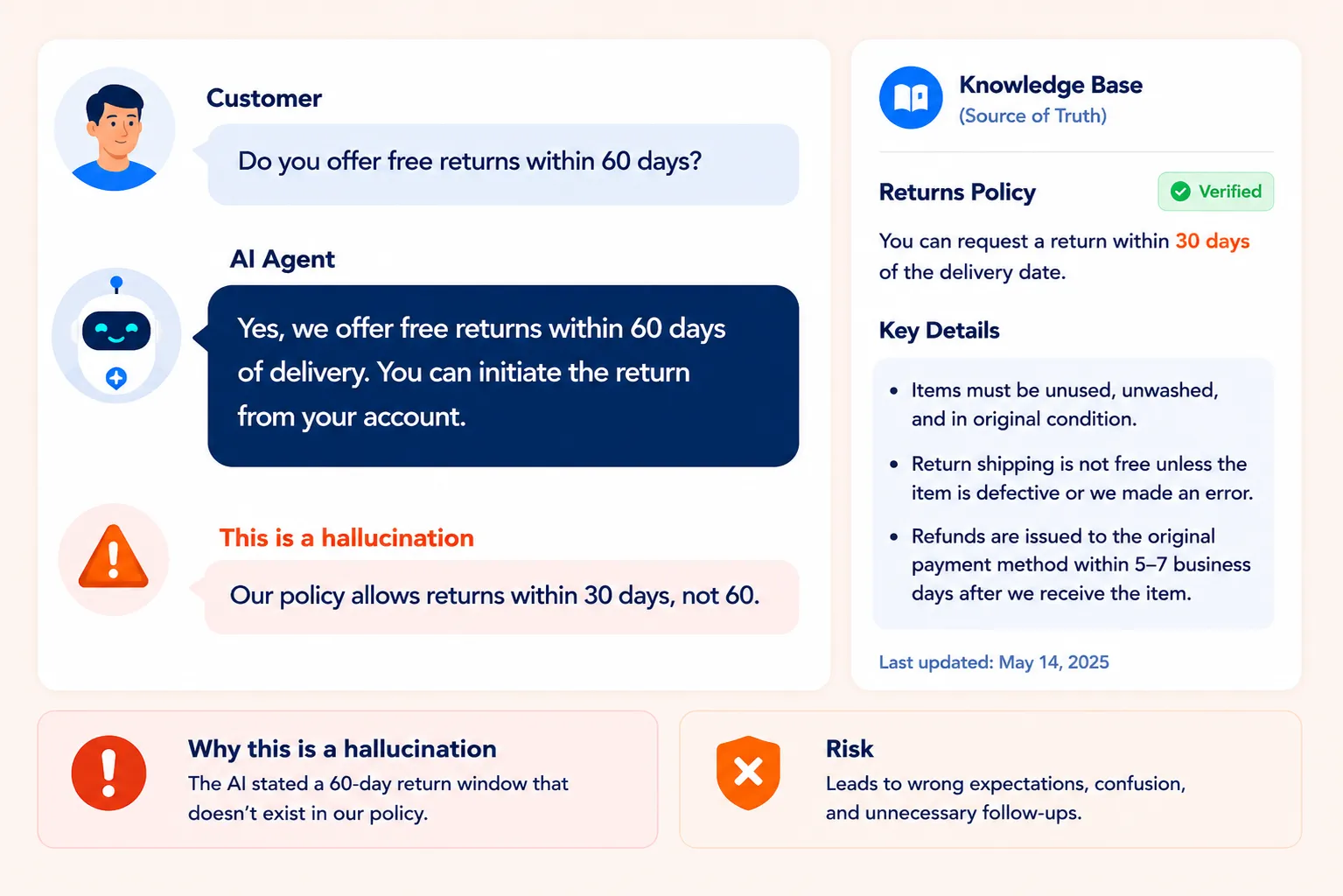
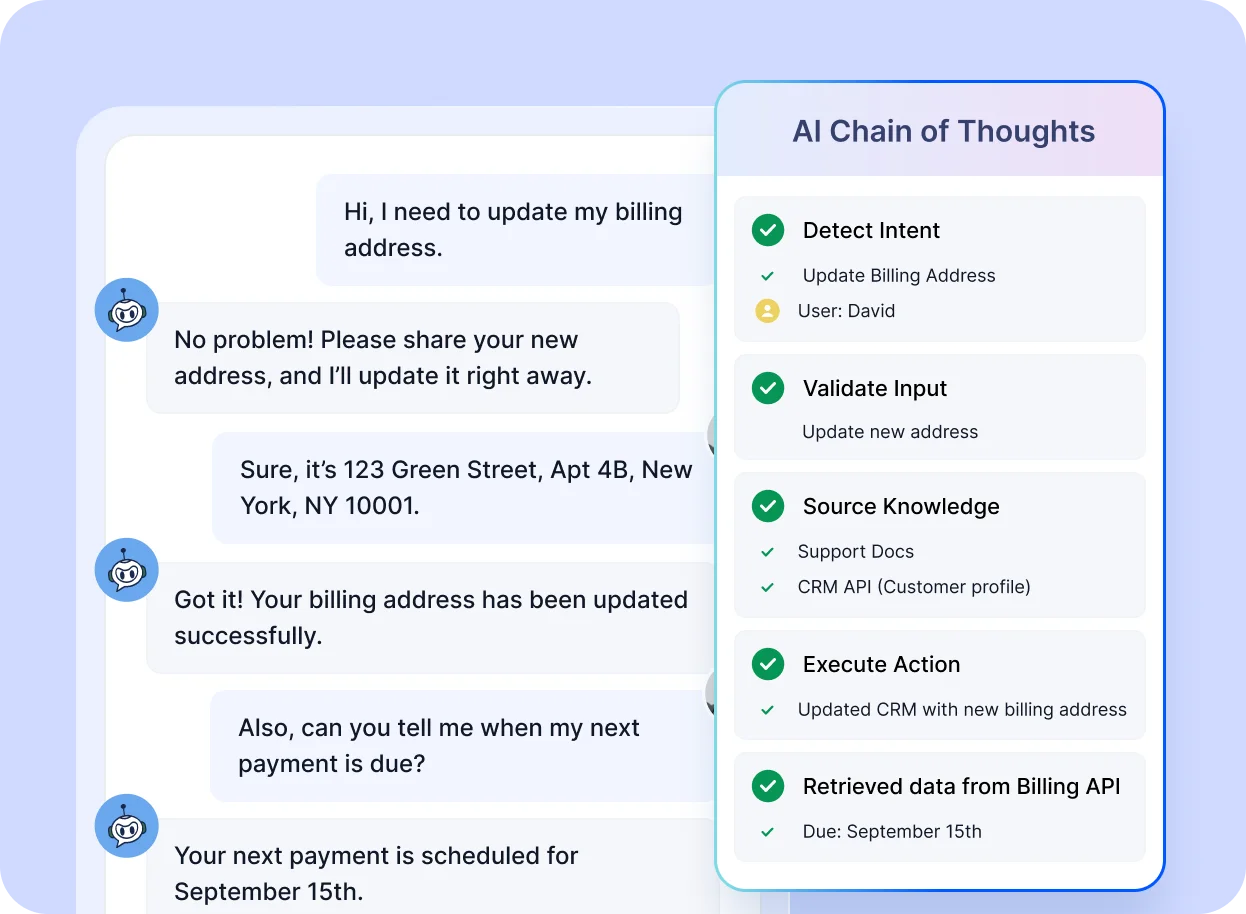
An example of an AI agent hallucinating in customer support
What causes AI hallucinations in customer service?
AI hallucinations in customer service rarely happen at random. Most occur because the system lacks reliable information, receives unclear guidance, or operates beyond its intended boundaries.
The most common causes of AI hallucinations in customer service include:
Outdated, incomplete, or limited information
When knowledge sources such as policies or training data are outdated or inconsistent, the AI may produce responses that do not reflect current business rules.
This issue often arises after product launches, pricing revisions, policy updates, or service changes that have not yet been incorporated into the AI’s knowledge base.
As a result, responses may be misleading or no longer aligned with the latest organizational standards.
Questions beyond the AI system’s approved scope
Support teams regularly encounter support scenarios involving exceptions, special requests, and account-specific decisions that require human judgment.
If the AI system is not configured to recognize these situations, it may attempt to answer instead of escalating the conversation appropriately.
This can result in inaccurate guidance, inconsistent decisions, or responses that should have been reviewed by a human agent.
Failure to retrieve the right information
Even when accurate information exists, AI can hallucinate if it fails to retrieve the most relevant content from the knowledge base or connected business systems.
This can happen when retrieval systems such as retrieval-augmented generation (RAG) are poorly configured or when the AI cannot access systems that contain current information.
The risk increases when information is spread across multiple systems or differs between sources. In these situations, the system may generate responses based on assumptions rather than verified data.
Misunderstanding customer queries or incomplete input from customers
Customers do not always describe issues using technical terms. They may use slang, abbreviations, vague descriptions, or incomplete information that makes their intent difficult to interpret.
When the system misunderstands the request or misses important context, it may retrieve the wrong information or generate a response that does not address the customer’s actual issue.
Weak escalation guardrails
Some AI systems are not configured to recognize when they are uncertain or when a customer request is too complex to handle safely. Without clear confidence thresholds, the system may continue answering even when it lacks enough context or verified information.
This becomes risky in situations involving refunds, billing disputes, account access, cancellations, or policy exceptions.
The business impact of AI hallucinations in customer service
AI hallucinations in customer service are not just technical issues. When inaccurate responses reach customers, they create measurable business impacts, including lost trust, repeat contacts, and operational risk.
Declining customer trust
Trust is the foundation of effective customer service. When AI delivers inaccurate information with confidence, even a single mistake can undermine confidence in future interactions.
Over time, this can drive more support escalations, reduce adoption of self-service channels, and increase the likelihood of customers turning to competitors.
Rising operational costs and support load
Incorrect AI responses often increase support workload instead of reducing it. When customers receive inaccurate information, they frequently return for clarification, reopen tickets, or require handoffs to human agents to resolve the issue correctly.
This leads to more support interactions, longer resolution times, and higher operating costs. Over time, these inefficiencies reduce the productivity and cost-saving benefits organizations expect from AI-powered customer service.
Exposure to compliance, legal, and financial risks
In regulated or high-stakes environments such as financial services and healthcare, hallucinated responses can create serious compliance, legal, and financial consequences.
Incorrect information about loan eligibility, insurance coverage, account access, or patient services may lead to disputes, penalties, or costly remediation efforts.
Real-life example:
In a case involving Air Canada, a customer relied on incorrect information provided by the airline’s chatbot about bereavement fare eligibility. When the airline later denied the claim, the tribunal ultimately held Air Canada responsible for the misinformation.
The case demonstrates how a single AI-generated error can quickly escalate into legal and financial consequences.
Damage to brand reputation
Unlike human errors that typically affect individual interactions, AI hallucinations can be repeated across many customer conversations before they are detected.
When these mistakes become visible through reviews, forums, or social media, they can damage brand perception at scale, making customers less likely to trust the company’s products, services, and support experience.
How to detect AI hallucinations in customer service
Detecting AI hallucinations early helps support teams maintain accuracy, protect customer trust, and reduce operational risk.
The following indicators help identify when AI responses may be unreliable:
- Inconsistent responses: When similar questions receive different answers, it often indicates that the system is not using a consistent source of information.
- Answers without supporting sources: If the AI cannot reference approved knowledge articles, policies, or documentation, it may be generating responses based on assumptions rather than company-approved information.
- Sudden drops in accuracy: An increase in incorrect answers, policy violations, or escalations after updates may indicate issues with retrieval, knowledge sources, or system configuration.
- Higher ticket reopen rates: Customers return with the same issue because the original AI response did not fully resolve their problem.
- More escalations to human agents: A growing number of conversations requiring agent intervention may indicate that the AI is struggling with accuracy, confidence, or context.
- Customer complaints about misinformation: Repeated reports of confusing, contradictory, or misleading responses are often a strong warning sign that the system is producing unreliable answers.
- Incorrect policies, pricing, or eligibility information: If the AI references fees, account requirements, or terms that do not exist in official company documentation, it is likely generating information rather than retrieving it from approved sources.
The role of AI governance in customer service
AI governance defines how AI is controlled and used in customer service. It sets clear rules for what AI can access, what it should handle, and when to involve a human agent, while establishing accountability for its performance.
Strong AI governance helps reduce the risk and impact of hallucinations by establishing:
- Clear boundaries that define what AI can and cannot do.
- Accountability frameworks for monitoring performance and addressing errors.
- Oversight mechanisms to review outputs and identify issues.
- Compliance and privacy controls to protect customer data and meet regulations.
- Auditability, allowing teams to trace data sources, system actions, and decision pathways.
Together, these controls create a safer foundation for AI-powered support before implementing more advanced hallucination prevention strategies.
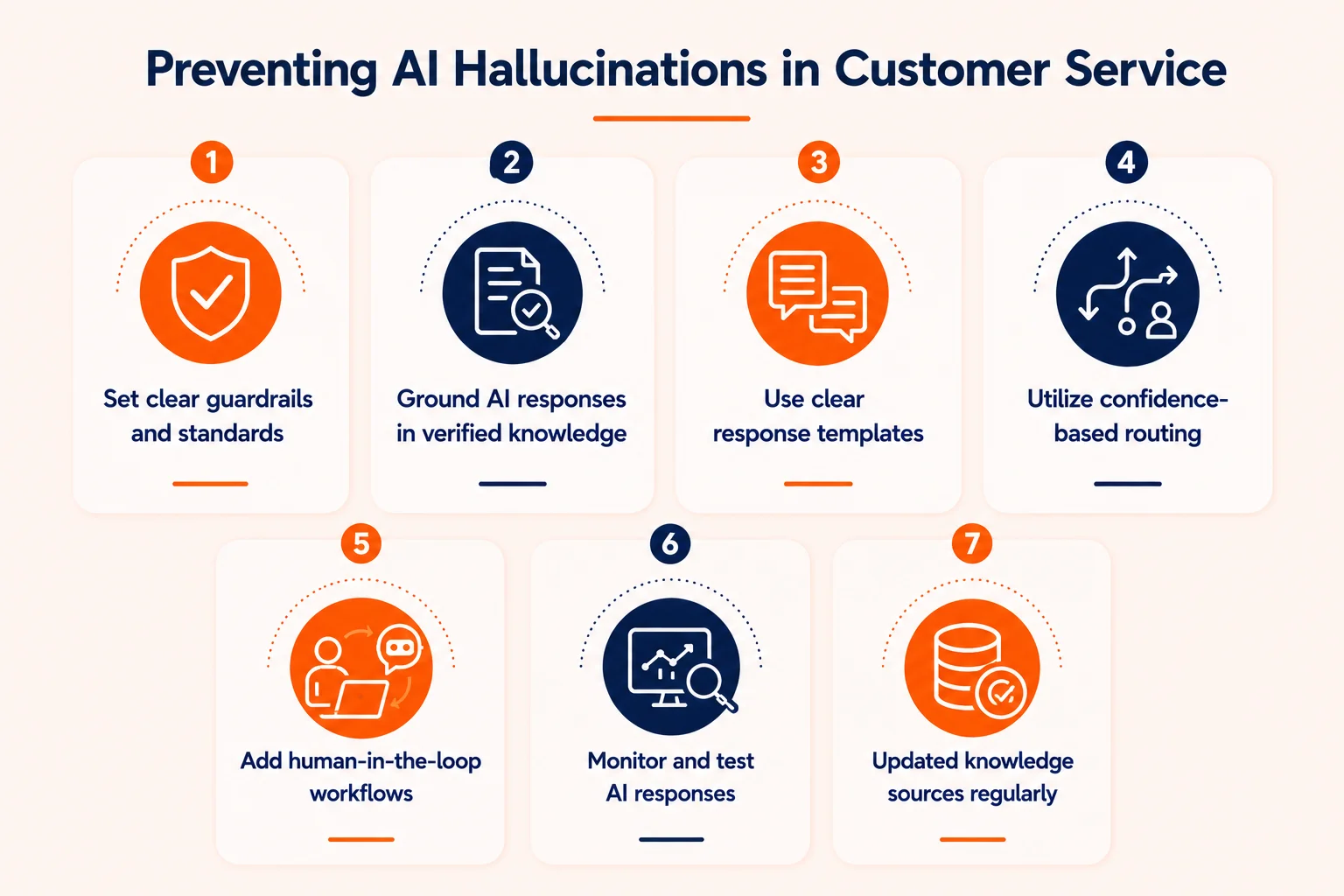
7 Practical ways to prevent AI hallucinations in customer service
Preventing AI hallucinations requires a combination of accurate knowledge, clear controls, and ongoing oversight.
Support teams need accurate knowledge sources, clear response boundaries, and ongoing monitoring to ensure AI-generated answers remain reliable and consistent.
The following strategies help reduce inaccurate AI responses and improve response reliability.
1. Set clear guardrails and response standards
AI systems should operate within clearly defined boundaries so they know what types of questions they can answer and when they should avoid responding.
Clear response standards, such as using concise factual language and acknowledging uncertainty when information is missing, help reduce misleading answers.
For example:
A customer service AI agent may handle order tracking or password reset requests but avoid making decisions about billing disputes or policy exceptions without human review.
2. Ground AI responses in trusted company knowledge
AI can sometimes generate incorrect or made-up answers, especially when it lacks accurate context. To reduce this risk, many support teams use retrieval-augmented generation (RAG).
RAG works by allowing the AI to first search your company’s knowledge base for relevant, approved, and up-to-date information before generating a response.
This approach depends on having a well-maintained, centralized knowledge base, which is a core capability of modern help desk platforms such as BoldDesk.
Instead of answering based only on what the AI model “thinks” is correct, the response is built using verified company content.
This helps ensure customers receive accurate, consistent, and reliable answers while reducing the chances of outdated or fabricated information appearing in conversations.
3. Use structured response templates
Structured templates guide how AI responses are generated while ensuring important details come from verified fields instead of free-form text generation.
This approach is especially useful for recurring support workflows such as delivery updates, appointment reminders, or account notifications.
A delivery update message could be structured like this: “Hello [customer name], your order [order number] was dispatched on [ship date] and is expected to arrive by [delivery date]. Track it here: [tracking link].”
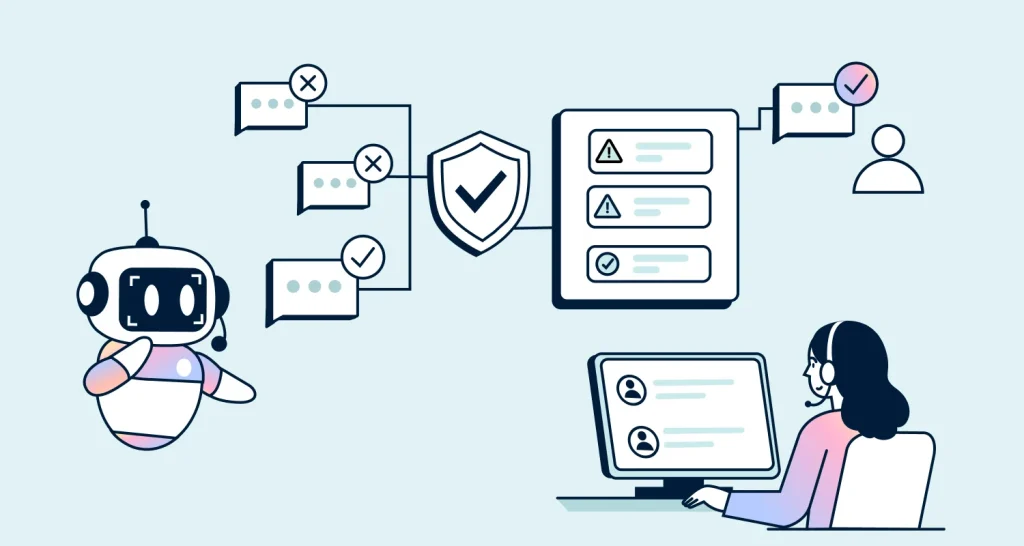
4. Use confidence-based routing and escalation
AI should evaluate how confident it is before responding to customers. If confidence is low or the request falls outside approved support scenarios, the system should ask clarifying questions or route the conversation to a human agent.
Confidence-based routing helps prevent AI from generating assumptions when reliable information is unavailable.
This is especially important for sensitive requests involving refunds, cancellations, billing issues, account access, or policy exceptions.

5. Add human-in-the-loop workflows
Human oversight helps ensure that high-impact or sensitive customer interactions receive proper review before incorrect information reaches customers.
For example, support teams may require human approval for refund decisions, account changes, payment disputes, or compliance-related requests generated by AI systems.
This keeps customer support accurate while improving credibility and accountability.
6. Continuously monitor and test AI responses
Preventing AI hallucinations requires ongoing testing and monitoring. Teams should regularly review AI conversations to identify inaccurate answers, edge cases, and recurring failure patterns.
Tracking metrics such as escalation rates, ticket reopen rates, customer complaints, and response accuracy helps teams detect issues early and improve system reliability over time.
7. Keep knowledge sources updated and centralized
AI responses are only as reliable as the information they retrieve. If policies, pricing details, or support workflows are outdated or scattered across multiple systems, the AI is more likely to generate incorrect responses.
Maintaining a centralized and regularly updated AI knowledge base helps ensure AI systems always reference the latest approved information, especially after product launches, pricing updates, or policy changes.
AI readiness checklist for reliable customer service
Before deploying or expanding AI across your support operations, it is important to verify that the right controls, knowledge sources, and oversight processes are in place.
Use the checklist below to assess your readiness and identify areas that may affect AI accuracy, consistency, and customer trust.
Building customer trust with reliable AI
AI in customer service only creates value when customers can rely on its answers. Even a single inaccurate response can weaken trust, create friction, and reduce confidence in automated support experiences.
Reducing AI hallucinations requires more than automation. Support teams need systems that keep responses accurate, consistent, and aligned with real business policies as customer conversations evolve.
Organizations that combine verified knowledge management, intelligent routing, and human oversight are better positioned to scale AI support without sacrificing customer trust.
BoldDesk helps teams achieve this through verified knowledge workflows, intelligent routing, and continuous conversation monitoring that improve response quality over time.
Ready to improve AI accuracy and customer trust? Start your free trial or book a demo to see how BoldDesk AI Agents help support teams deliver faster, more consistent, and more trustworthy customer experiences.
How is your team reducing AI hallucinations in customer service? Share your experiences or strategies in the comments below.
Related articles
- AI for Customer Engagement: Boosting Customer Experience at Scale
- How to Build AI Agents with BoldDesk for Smarter Support
- 8 Practical Ways to Use Generative AI in Customer Service
FAQs
When an AI provides confident but incorrect answers, it creates confusion and frustration. Over time, repeated inaccuracies lead to reduced customer loyalty and higher churn.
Yes. AI hallucinations still occur even when correct data exists if the AI system does not retrieve the right information at the right time, misunderstands context, or prioritizes fluency over accuracy.
AI errors lead to unresolved issues, repeated support contacts, and reduced confidence in self‑service channels, ultimately driving customers back to live support and increasing operational costs.
Teams commonly track response accuracy rates, escalation frequency, contradiction reports, and customer feedback signals such as reopens or dissatisfaction scores.
No. AI hallucinations cannot be eliminated entirely, but they can be significantly reduced through strong system design, governance, and continuous monitoring.
Using trusted knowledge sources and human oversight in sensitive or complex scenarios helps reduce AI hallucination risk and improve response reliability.
Companies can improve by grounding responses in approved knowledge sources, adding escalation rules, monitoring AI accuracy, and requiring human review for sensitive issues.