

TL;DR: AI agents in customer support transform service in 2026 by automating repetitive tasks, resolving queries faster, and executing workflows autonomously. They enhance efficiency, reduce costs, and scale operations, while a hybrid model ensures humans handle complex, emotional, and high-value interactions for a superior customer experience.
Customers today expect instant answers, not queues, delays, or repetitive back-and-forth for simple requests. This shift is reshaping customer support faster than ever.
AI agents in customer support are emerging as the solution, enabling modern teams to handle growing demand without straining resources. Your team’s expertise should focus on complex, high-value interactions, not routine tasks like password resets or order updates.
As more customers turn to self-service, the gap between manual support models and rising expectations continues to widen. AI agents close this gap by delivering faster, more efficient assistance at scale.
With customer service automation becoming central to modern support, agentic AI is set to resolve 80% of customer service issues by 2029, eliminating manual sorting and speeding up resolutions (Gartner).
In this guide, we’ll explore how AI agents are reshaping customer support in 2026, including their capabilities, use cases, benefits, implementation steps, and challenges.
What are AI agents in customer support?
AI agents in customer support are autonomous software systems that understand customer requests, make decisions, execute actions, and resolve issues with minimal human intervention.
Unlike traditional chatbots that follow predefined scripts, AI agents operate autonomously by gathering information, evaluating situations, and carrying out tasks while handling complex, multi-step interactions conversationally using natural language processing and machine learning.
As a result, they move beyond simple question-and-answer exchanges to deliver end-to-end problem resolution, making them a critical evolution in modern customer support systems.
Want to see it in action? BoldDesk’s AI agents work seamlessly across your support channels, helping teams resolve requests faster and without the chaos. Start a 15-day free trial and experience smarter, scalable customer support today.
How AI agents in customer service work
AI agents function through a combination of advanced technologies that enable them to understand language, analyze context, and make intelligent decisions.
Here are the key ways they deliver value:
- Understand customer needs faster with intent recognition: AI agents interpret customer queries using natural language processing (NLP) while incorporating context from CRM systems, past interactions, and knowledge base data to fully understand the request.
- Deliver smarter responses with real-time decision-making: AI support agents evaluate each situation using trained models and predefined logic to determine the most relevant and effective response, improving accuracy and consistency.
- Resolve requests instantly with automated execution: Once a decision is made, customer service AI agents can respond directly or take action, such as updating tickets, retrieving data, or triggering workflows, which reduces effort and speeds up resolution times.
- Continuously improve through learning from outcomes: AI agents analyze results like resolution success, escalation rates, and policy compliance to refine future decisions, improving accuracy, efficiency, and alignment with service standards over time.
Example of how an AI agent works in customer support
A customer asks, “Where is my order?” in the chat, and the AI agent instantly identifies the user, retrieves their order details, and checks the shipping status in real time. It then replies with an update like, “Your order was shipped yesterday and will arrive by June 20, here is your tracking link.”
The entire interaction happens within seconds with no need for human involvement, while still delivering accurate and personalized support.
Types of AI agents in customer support
AI customer support agents can be categorized by their primary role or capability.
The five most common types include:
- Voice AI agents: Handle real-time phone interactions (inbound and outbound), automating tasks like intake, appointment booking, order tracking, and FAQs, reducing call center volume and wait times.
- Digital AI agents: Operate across chat, SMS, and email, enabling teams to scale customer support without increasing headcount while maintaining fast, consistent responses.
- Agent assist AI: Works alongside human agents as a real-time copilot, providing suggestions, surfacing knowledge, and guiding responses during live interactions rather than replacing agents.
- Sentiment and intent agents: Analyze conversations in real-time to detect sentiment and intent, giving supervisors visibility and enabling proactive intervention before issues escalate.
- Proactive agents: Initiate customer interactions based on behavior, events, or predictive signals, such as notifying users about delays or prompting actions before issues arise.
AI agents vs chatbots vs AI copilots: What’s the difference?
While these technologies are often grouped together, they differ significantly in how they operate, the level of autonomy they provide, and the value they deliver.
The following table shows where each one fits within your support strategy.
| Aspect | Chatbots | AI copilots | AI agents |
| Core nature | Rule-based or scripted conversational systems | Assistive AI for human agents | Autonomous AI, action-oriented systems |
| Behavior | Reactive (responds to user input) | Reactive with context-aware assistance | Goal-driven, can be proactive and multi-step |
| Human involvement | Optional (often required for complex issues) | Required for decision and execution | Minimal to none |
| Capabilities | Predefined responses | Suggests replies, insights, next-best actions | Executes tasks and completes workflows autonomously |
| Decision making | Follows predefined logic | Recommends decisions for human approval | Makes and executes decisions autonomously |
| System access and actions | Limited or none | Surfaces information but does not execute actions | Accesses systems and executes actions (e.g., refunds, updates, workflows) |
| Learning ability | Limited (typically rule-based or lightly adaptive) | Learns from data and interactions | Continuously learns and adapts across tasks and systems |
| Flexibility | Low | Moderate | High |
| Example scenario | Answers “What are your hours?” | Suggests response to a customer query | Resolves issue, processes request, follows up |
| Value delivered | Efficiency in simple queries | Improved human agent productivity | End-to-end automation and scalability |
AI agents represent the shift from simple automation and human assistance to fully autonomous service delivery, making agentic AI a key competitive advantage in modern customer support.
What AI agents can and cannot do
Autonomous AI agents can handle a wide range of customer support tasks, but their effectiveness depends on understanding where they perform best and where human involvement remains essential.
The most effective support strategies blend AI efficiency with human judgment to deliver reliable and high-quality customer experiences.
What AI agents handle well
AI agents are most effective when applied to structured, high-volume tasks where speed and consistency are key.
Here are the areas where they deliver the most value:
- Handle high-volume, repetitive queries: AI agents excel at resolving recurring requests with consistent patterns. By eliminating queues and providing immediate responses, they significantly reduce response times while maintaining quality.
- Route and prioritize requests intelligently: AI agents analyze intent, context, and metadata in incoming requests to automatically triage and assign them to the right workflows or teams. This reduces manual sorting and improves resolution efficiency.
- Provide real-time updates and continuity: AI agents keep customers informed throughout a process by retrieving and delivering up-to-date information instantly. This reduces uncertainty and prevents unnecessary follow-ups.
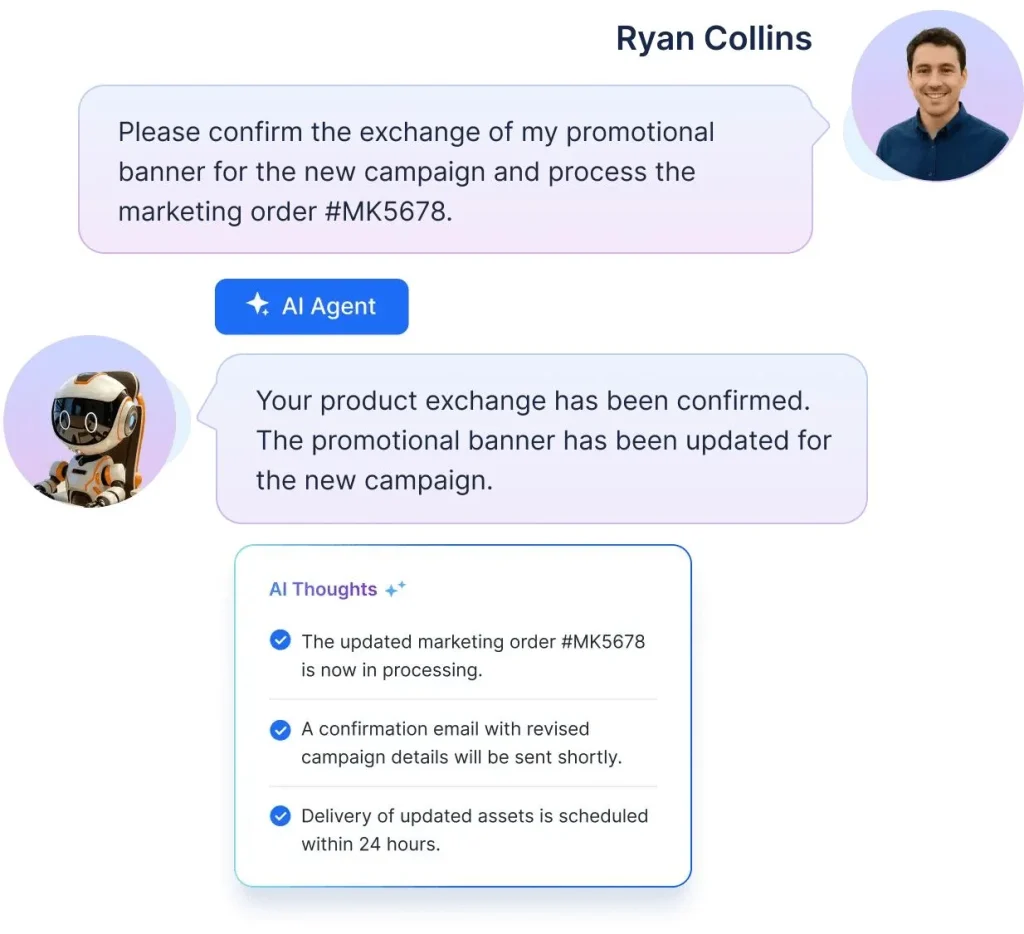
- Retrieve and apply information across systems: Modern AI agents go beyond surface-level answers. They can access knowledge bases, customer records, and internal systems to deliver context-aware responses across interactions.
These strengths make AI agents a powerful tool for boosting efficiency, reducing response times, and delivering consistent support at scale in modern customer service.
Where humans still matter
While AI agents excel at automation, there are key scenarios where human expertise remains essential.
Here are the areas where human involvement is critical:
- Emotionally sensitive situations: When customers are frustrated, confused, or upset, human agents provide empathy, reassurance, and nuanced communication that AI cannot fully replicate.
- Handling complex problems: Issues that lack clear patterns or require deep investigation often demand human judgment, creativity, and adaptability.
- Smart decisions for unusual cases: When cases fall outside standard rules or policies, humans can interpret context and make fair, situation-specific decisions.
- High-value or relationship-driven interactions: VIP customers and strategic accounts often expect personalized support and relationship-building that goes beyond automation.
The most effective customer support strategies use a hybrid model, where AI agents handle speed, scale, and consistency, while human agents focus on judgment, empathy, and complex problem-solving.
Key features to look for in an AI support agent platform
Choosing the right AI agent platform goes beyond checking feature boxes. The best platforms enable AI agents to understand context, take action across systems, and resolve customer requests efficiently from the start.
Below are the key factors to consider when evaluating an AI agent platform:
- Advanced language understanding and reasoning: The platform should provide strong language understanding and reasoning capabilities, enabling accurate interpretation of intent, context, and multi-step conversations, even for complex queries.
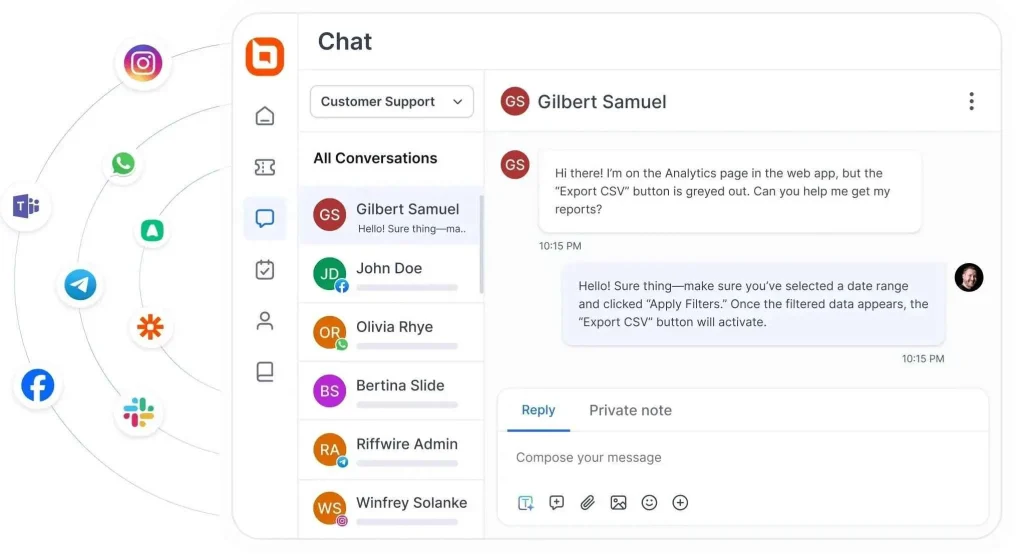
- Omnichannel support (with shared context): Customers expect to move across channels seamlessly. A capable platform maintains context across live chat, email, messaging, and voice, so customers don’t have to repeat themselves each time they switch channels.
- Streamlined workflow automation: The platform should support multi-step processes such as automated ticket routing, escalations, and follow-ups, ensuring support operations run smoothly without manual intervention.
- Deep integrations with existing systems: Seamless connections with CRM, help desk, billing, and internal tools enable AI agents to access real-time data and take action within a single workflow.
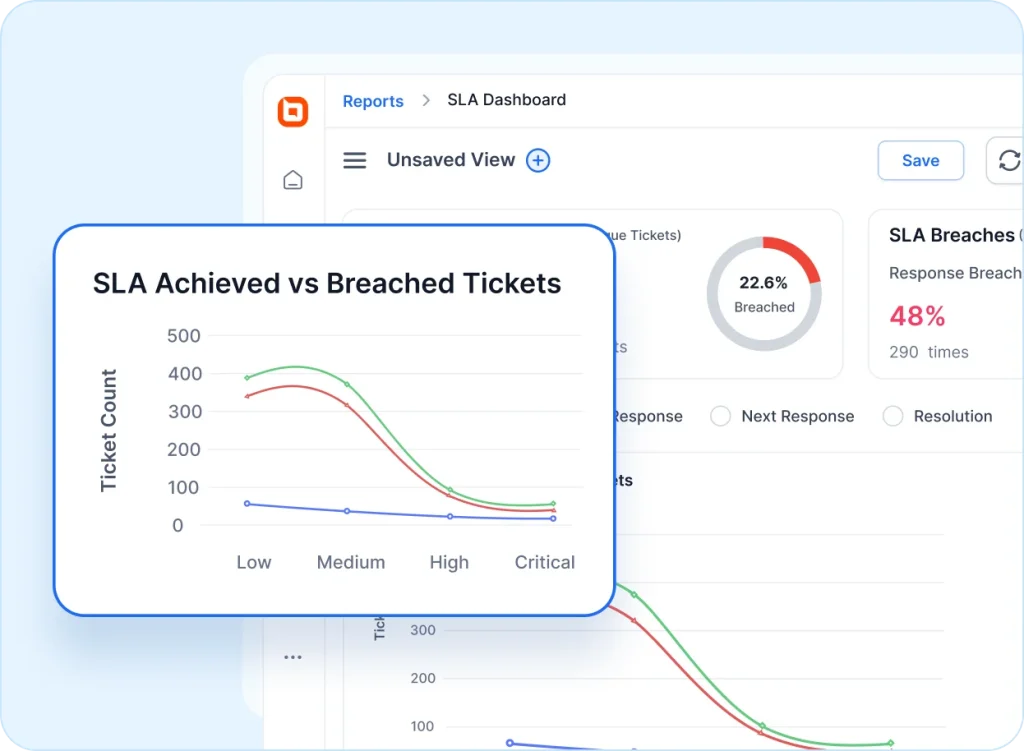
- Performance analytics and continuous learning: Built-in analytics should track resolution rates, response times, escalation patterns, and customer satisfaction, helping teams optimize both AI performance and overall support operations.
- Seamless human handoff and collaboration: When escalation is needed, the platform should transfer conversations to human agents with full context, including history, intent, and actions taken, ensuring continuity and avoiding repetition.
- No-code agent builder: A no-code agent builder enables support teams to quickly create, deploy, and manage AI agents using simple visual tools, allowing them to connect systems, automate workflows, and scale AI-powered support without relying on complex coding or developer resources.
Benefits of using AI agents in customer service
When businesses implement AI agents effectively, they do more than improve efficiency. AI agents transform customer support by enabling faster resolutions, reducing manual work, and handling entire customer requests autonomously.
Organizations adopting AI in customer service are seeing measurable impact. Deloitte reports that 73% of organizations say AI has increased customer satisfaction.
Here are the key benefits of using AI agents in customer support:
- Reduce support costs with smarter automation: Instead of expanding teams to manage routine tasks, AI agents handle repetitive, high-volume work, helping lower operational costs while maintaining service quality.
- Scale support without added complexity: As demand increases, AI agents manage the additional workload seamlessly, enabling your customer support operations to grow without requiring more tools, processes, or staff.
- Instant resolution with no waiting: As soon as a customer reaches out, AI agents respond and take action immediately, resolving issues in seconds without queues, delays, or unnecessary back-and-forth.
- Consistent, policy-aligned support every time: Every interaction follows the same rules and logic, ensuring customers receive accurate and reliable responses without the inconsistencies of manual handling.
- Support that never goes offline: Whether it’s late at night or during peak hours, AI agents remain available at all times, giving customers continuous access to help whenever they need it.
The right AI agent platform does more than assist your support team. It strengthens your entire customer experience by combining speed, consistency, and intelligent automation at scale.
Practical AI agent use cases in customer support
AI customer support agents are becoming a core part of modern customer support by not just responding to requests, but actively resolving issues, automating workflows, and supporting teams across the entire support lifecycle.
Below are real-world scenarios where AI agents deliver value, along with how they benefit both customers and support teams.
1. Customer-facing use cases
In scenarios where customers interact directly with support systems, AI agents handle common requests through channels such as chat, email, or in-app interfaces.
These interactions typically involve repetitive needs like tracking orders or guiding users during onboarding, as illustrated in the examples below.
Reduce support volume with real-time order tracking
One of the most common customer questions is, “Where is my order?” AI agents handle these repetitive queries instantly by integrating with logistics and order management systems to retrieve live updates.
Customers receive immediate and accurate answers without needing to contact support, while teams benefit from reduced ticket volume and improved response efficiency.
Example: Shopify, a global e-commerce platform, enables AI chatbots that retrieve real-time tracking data and instantly answer order status queries, reducing repetitive support requests.
Guided onboarding and product adoption
Getting started with a new product should feel simple and intuitive. AI agents enhance the experience by tracking user behavior in real-time and offering step-by-step, contextual guidance exactly when it is needed.
Instead of relying on static tutorials, users receive personalized walkthroughs, feature recommendations, and interactive support that help them reach their first milestone faster, without human assistance.
This leads to smoother customer onboarding, quicker adoption, and reduced early churn.
Example: Marsroad, an IT services company, uses structured workflows and centralized knowledge to guide new users and support agents, ensuring faster onboarding and consistent experiences.
2. Operational efficiency use cases
Operational efficiency use cases focus on improving internal support processes by reducing manual work and accelerating issue handling. These involve backend activities such as ticket management and resolution workflows.
Intelligent ticket triage and routing
AI-powered agents automatically analyze incoming tickets to understand intent, urgency, and context. This removes the need for manual categorization.
Urgent issues are prioritized and routed to the right team immediately, improving resolution speed and reducing delays.
Example: GeoVerra, a mapping and GIS services company, modernized its IT support using BoldDesk, centralizing requests and automating workflows to reduce manual sorting and accelerate issue resolution.
Autonomous end-to-end issue resolution
AI agents handle complete support workflows independently, from understanding requests to taking action and confirming outcomes.
They go beyond responses by making decisions, executing tasks across systems, and resolving issues without human involvement when appropriate.
This shift to autonomous resolution reduces resolution time and operational overhead.
3. Agent support use cases
AI support agents focus on helping human agents work more efficiently by providing real-time assistance and insights during support interactions.
Smart escalation and human handoff
AI agents continuously monitor interactions to detect when human support is needed, using signals such as customer sentiment, repeated issues, or signs of frustration.
When escalation is required, they seamlessly route the case to the right agent, along with full context and conversation history, ensuring a smooth and efficient handoff without disrupting the customer experience.
Real-time agent assist and productivity
AI agents also empower support teams during live interactions by suggesting responses, summarizing conversations, and recommending next best actions.
This reduces cognitive load, improves response consistency, and enables faster and more confident resolutions.
Together, these use cases show how AI agents move beyond simple automation to handle complete workflows, improve resolution speed, optimize workload, and enhance both customer and agent experiences.
Steps to implement AI agents in customer support
Adopting AI agents in customer support is not just a technical upgrade but a shift toward automated, action-oriented service. When used effectively, AI agents can resolve customer requests, streamline operations, and significantly improve both efficiency and the overall customer experience.
Below are the key steps to successfully adopt AI agents in customer support and drive meaningful results.
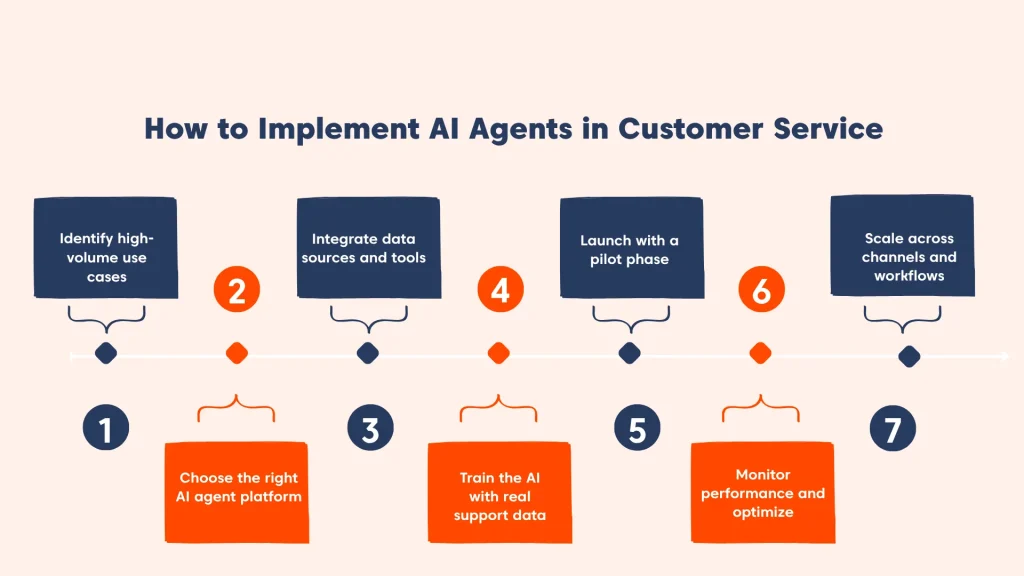
1. Identify high-impact use cases
Start by identifying repetitive and high-volume support requests such as FAQs, order status, or billing queries. These are ideal starting points where AI can deliver quick wins without disrupting complex workflows.
To prioritize effectively, analyze your support data by focusing on:
- Most common ticket types
- Average handling time
- Areas with delays or backlogs
Targeting these use cases helps you achieve quick wins while building momentum for broader adoption.
2. Choose the right AI agent support platform
Selecting the best AI agent platform is critical to long-term success. Look beyond basic automation capabilities and evaluate how well the solution fits into your existing ecosystem.
A strong AI agent platform should:
- Enable end-to-end task execution (not just responses)
- Provide control and guardrails for AI actions
- Support continuous learning and optimization
The goal is to choose a platform that not only solves current challenges but also evolves with your business needs.
3. Integrate data sources and core systems
AI agents in customer support rely on data to deliver accurate and relevant responses. Without proper integration, even the most advanced AI will have limited impact.
Connect your AI agent to key systems such as:
- CRM for customer history and context
- Knowledge base for accurate answers
- Internal workflows and support tools
This allows AI agents not only to provide accurate responses, but also to take action, such as updating records, retrieving order details, or triggering workflows in real-time.
4. Train the AI with real support data
Use past conversations, support tickets, and knowledge base content to guide how the AI interprets requests and responds. This includes defining tone, workflows, and how the AI should handle different scenarios.
Focus on:
- Frequently asked questions and common issues
- Preferred tone and communication style
- Edge cases and variations in customer queries
The more context-rich and representative your training data is, the better your AI will perform. This step also helps ensure your AI reflects your brand voice and delivers consistent messaging.
5. Launch with a focused pilot program
Instead of rolling out AI across your entire support operation, start with a controlled pilot program. Choose a specific use case, channel, or customer segment to test performance in a real-world environment.
Start with low risk, well defined use cases before expanding to more complex scenarios.
During the pilot phase:
- Monitor how accurately the AI resolves queries
- Identify gaps in responses or understanding
- Collect feedback from both customers and support agents
This approach reduces risk and allows you to fine-tune the system before scaling. It also builds confidence across your team by demonstrating tangible results early on.
6. Monitor performance and continuously optimize
AI implementation is not a one-time setup. Ongoing monitoring and optimization are essential to maintain performance and relevance.
Track key metrics such as:
- Resolution rate and accuracy
- Response time improvements
- Customer satisfaction scores
Use these insights to refine workflows, improve training data, and expand capabilities over time. Continuous optimization ensures your AI keeps improving as customer expectations evolve.
7. Scale across channels and workflows
Once proven, expand the AI’s role progressively, moving from simple queries to more complex workflows and advancing from a single channel to a fully omnichannel customer service platform.
For example, you can move from handling FAQs to:
- Supporting onboarding journeys
- Assisting agents in real-time
- Managing more complex workflows like returns or billing disputes
Scaling in phases ensures stability while maximizing the long-term impact of your AI investment.
If you’re exploring how to implement AI effectively, check out our AI customer support playbook, which provides a step-by-step guide to modernizing your support strategy.
What are the challenges of AI agents in customer service?
While AI agents can significantly improve customer support, they also introduce new operational, technical, and experience-related challenges.
Below are the key challenges that organizations must address to successfully implement AI agents in customer support.
- Data quality and knowledge grounding: AI agents rely heavily on the quality of the data and systems they are connected to. If information is incomplete, outdated, or inconsistent, the responses and actions they generate can be inaccurate. Strong data governance and continuous refinement are essential to maintain reliability.
- Integration and system complexity: AI agents depend on deep integrations with CRM systems, support tools, and backend platforms. Without proper integration, they may lack both the context and the ability to take action, which limits their effectiveness and reduces their overall value.
- Lack of customer trust: Not all customers are comfortable interacting with AI, especially in sensitive situations. Building trust requires transparency, clear communication about when AI is being used, and seamless escalation to human agents when needed.
- Compliance, privacy, and security risks: AI agents often handle sensitive customer data, making compliance with data protection regulations essential. Organizations must ensure secure data handling, access controls, auditability, and alignment with internal policies to reduce legal and reputational risk.
- Organizational readiness and change management: Adopting AI agents requires changes in workflows, team roles, and processes. Without proper training and alignment, teams may struggle to adopt the technology effectively or trust its outcomes.
Successfully addressing these challenges is what separates basic automation from truly effective, AI-driven customer support that delivers both efficiency and high-quality customer experiences.
Building a scalable AI-powered customer service strategy
AI agents are becoming a core part of modern customer support. They help teams deliver faster, more consistent, and scalable service.
Their real value lies in working alongside human agents. AI handles repetitive tasks and high-volume requests, while humans focus on complex issues and customer relationships.
To get the most out of AI, start with high-impact use cases, prove value early, and scale gradually across channels. This approach helps you build a strong, future-ready support strategy.
Choosing the right platform also matters. Platforms like BoldDesk make it easier to automate workflows, integrate systems, and enable seamless collaboration between AI and human agents.
Schedule a live demo to see how BoldDesk AI agents can streamline support operations, reduce workload, and deliver faster, more consistent customer experiences.
Related articles
- Automated Customer Service – The Complete Details
- AI Agent Examples: 21 Real-World Use Cases Across Industries (2026)
- Microsoft Build 2026 AI Customer Support: The Rise of AI Agents
Frequently Asked Questions
Yes, AI agents are built with strong security features such as data encryption, access controls, and compliance with regulations like GDPR. When implemented correctly, they keep customer data safe while ensuring privacy and trust.
AI agents help businesses save money by automating repetitive tasks and reducing the workload on human teams. They also improve response times and customer satisfaction, leading to better retention and overall efficiency, delivering strong returns on investment.
Yes, modern AI agents can communicate in multiple languages and provide real-time support to global customers. This helps businesses deliver consistent service across different regions and improve accessibility.
AI customer support agents are not a complete replacement for humans. While they excel at handling routine interactions, human agents remain essential for complex problem-solving, emotional situations, and high-value customer relationships.
No, AI agents are not expensive to deploy overall; they are generally cost-effective. Although there may be some upfront costs for setup and integration, AI agents help reduce long-term expenses by automating repetitive tasks, improving efficiency, and lowering the need for additional staffing.