


TL; DR: If you keep saying “thank you for your understanding,” it can sound generic. Use the alternatives below, grouped by situations like delays, outages, and policy changes, to sound more human, calm, and professional.
“Thank you for your understanding” might sound polite, but in customer service, it often feels overused and impersonal.
If you’ve ever written it in emails, ticket responses, or live chat replies, you’re not alone.
Customers have seen it so many times that it can come across as robotic instead of empathetic.
In this guide, you’ll find 20+ better alternatives grouped by situation, such as delays, mistakes, and policy updates, so you can sound more human and deliver better customer experiences in every interaction.
What does thank you for your understanding mean?
“Thank you for your understanding” is a professional phrase used to recognize someone’s patience or flexibility during a delay, inconvenience, change, or service issue.
It is commonly used in customer service emails and announcements to acknowledge the customer experience while resolving the problem and communicating updates.
Common situations where “thank you for your understanding” is used
The phrase “thank you for your understanding” is commonly used in situations where you want to express gratitude to someone for being patient or accommodating in response to a particular circumstance, often preemptively.
Here are some situations where it’s appropriate to utilize “thank you for your understanding”:
Following a delay or service disruption
“Thank you for your understanding” is often used after explaining a delay, outage, schedule change, or other service disruption.
The phrase acknowledges the customer’s patience while the issue is being resolved or communicated.
Requesting patience
If an issue is ongoing, this phrase can be used to ask for time to resolve it. If the issue is affecting many customers, send a blanket email or post a pop-up with a warning on your website.
Including “thank you for your understanding” in these updates acknowledges customer patience while your team works toward resolving a customer complaint.
Addressing customer concerns
When customers express concerns about a decision, timeline, or limitation, “thank you for your understanding” can help acknowledge their perspective after you’ve provided a clear explanation.
This works best when expectations have been communicated transparently.
Communicating policy or service changes
When announcing policy, pricing, or service changes, “thank you for your understanding” can help acknowledge customer concerns while maintaining a professional tone.
The phrase is most effective after clearly explaining the reason for the change and how it affects customers.
When to use “thank you for your understanding” in professional communication
“Thank you for your understanding” can still be effective, but only in specific situations where context, timing, and intent align.
The following are some of the common scenarios where the phrase can work best.
- After communicating a planned or expected delay: In these situations, the phrase serves as a polite acknowledgment of the customer’s patience. Because expectations were shared upfront, the appreciation feels appropriate and earned.
- When the customer has already acknowledged or accepted the situation: If a customer confirms that they understand the issue, such as by accepting revised timelines, the phrase works well as a closing statement that reflects mutual understanding.
- In low‑emotion updates: “Thank you for your understanding” is suitable for neutral updates where urgency and emotion are minimal, helping maintain professionalism without risking misinterpretation.
- When the issue has been resolved or is near resolution: Once clear progress has been made, the phrase can acknowledge the patience shown throughout the process, reinforcing a positive end to the interaction.
- After accountability is shown: The phrase should only follow clear ownership or explanation. When accountability comes first, “thank you for your understanding” reads as supportive rather than dismissive.
Why do businesses use “thank you for your understanding” so often in customer support?
In customer service, this phrase often becomes a default, not because teams lack empathy, but because everyday operational challenges make delays and uncertainty unavoidable.
In fact, according to a Microsoft survey, 95% of the respondents said that the quality of customer service influences their brand choice and loyalty.
For example
A customer reaches out after noticing an issue with their account. The support team acknowledges the request, but due to high ticket volume and limited visibility into the issue, it takes longer than expected to follow up.
As time passes, the safest and quickest way to respond without over‑promising becomes a familiar phrase: “Thank you for your understanding.”
Below are common situations that explain why businesses rely on it so frequently.
- Ticket surges during peak periods: High volumes make fast, personalized responses difficult, and the phrase helps acknowledge the request while work is underway.
- Response times exceeding expectations: When replies take longer than anticipated, the phrase reassures customers that their message hasn’t been ignored.
- Issues requiring multiple follow-ups: Complex cases often involve back-and-forth communication, and neutral phrasing helps maintain a constructive tone.
- Limited visibility into ticket status: When agents lack real-time updates, familiar language helps maintain consistency until clearer information is available.
- Manual workflows slowing resolution: Process-heavy support environments rely on respectful language to maintain trust when speed falls short.
“Thank you for understanding” alternatives to use in your communications
The phrase “thank you for your understanding” can be replaced with other appropriate ways to show appreciation for customers’ patience.
The best alternative depends on why you’re thanking the customer. Some phrases work better for delays, while others fit policy changes, troubleshooting, or customer feedback.
The examples below help you choose the most natural response for each situation.

1. “Thank you for sharing this information”
When a customer reports that something has gone wrong with the company website, let them know you’re working on fixing the problem. Then, show appreciation for bringing it to your attention.
Three other ways to say “Thank you for sharing this information”:
a. “We appreciate the information.”
b. “Your information is much appreciated.”
c. “Thank you for providing these details.”
For example:
Dear [Name],
Thank you for sharing this information with us. I have sent it to the appropriate team member, and we hope to have everything resolved soon.
Best regards,
[Your Name]
2. “I appreciate your comprehension”
Saying “I appreciate your comprehension” is a helpful way for non-native English speakers to express gratitude for their ability to understand an idea or situation.
Compared to saying, “thank you for your understanding,” this phrase conveys appreciation more articulately and clearly.
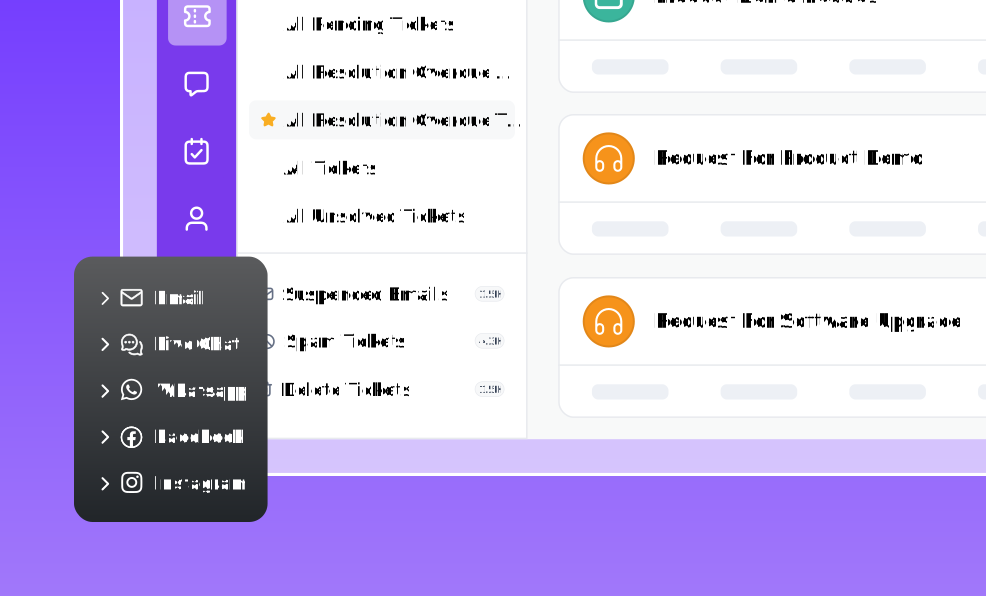
One Unified Inbox for Every Communication Channel!
Manage all customer service chats, emails, and social messages in one inbox. Stay connected and support customers anywhere.

Three other related expressions for “Thank you for your comprehension”:
a. “Grateful for your support”
b. “Value your tolerance”
c. “Appreciate your acceptance”
For example:
Dear [Name],
I want to express my sincere gratitude for your understanding. Your ability to understand and empathize with the situation has been incredibly reassuring.
Your patience and understanding have made navigating this matter much smoother, and I truly appreciate your thoughtful approach.
With gratitude,
[Your Name]
3. “We appreciate your flexibility”
“Flexibility” assumes there will be a solution. This phrase acknowledges that customers are making an accommodation.
It indicates that whatever has gone wrong requires customers to wait some time or perform a workaround to achieve their original intent.
Three similar phrases for “Thank you for your flexibility”:
a. “We’re grateful for your adaptability.”
b. “Thank you for being so accommodating.”
c. “I value your willingness to adjust.”
For example:
Dear Customers,
On behalf of [company], I want to extend my genuine appreciation for your flexibility.
We realize the downtime has been an inconvenience, and we’re working on pinpointing the cause.
For now, everything is back online, so you can continue to use [system] as before.
Those customers who submitted requests via email will have them transferred to the [system] within 24 hours.
Thank you again for working with us on this while we sorted everything out.
Sincerely,
John Doe
[Company] CTO
4. “We are grateful for your patience”
Saying, “We are grateful for your patience,” is a more direct way of asking people to stay calm while you figure out how to fix what went wrong.
It expresses acknowledgment and appreciation for their willingness to tolerate delays or challenges without complaint.
Not only does it still set expectations of behavior, but it also assures them that their issues are being addressed. It doesn’t demand empathy, either, just time and space.
Two other alternative ways to say “We are grateful for your patience”:
a. “We are thankful for your patience.”
b. “We appreciate your tolerance.”
For example:
Dear [ Name],
Thank you for bringing this issue to our attention. We are doing everything we can to resolve the matter on our end.
We will let you know as soon as we’re finished. We’re grateful for your patience as we sort this out.
Sincerely,
[Your Name]
5. “We are committed to helping you with this”
This phrase can be more helpful than “Thank you for your understanding.” It shows that, despite the bad news, you are determined to help customers solve the issue.
Instead of telling customers how to behave while you do, it just reassures them that you are taking them seriously and actively seeking a solution. This can be even more calming than reminding them of their manners.
Three other reassuring phrases for “We are committed to helping you with this”:
a. “We are dedicated to assisting you with this matter.”
b. “I am devoted to finding a solution.”
c. “We will be working on this until we find a solution.”
For example:
Dear [Name],
Thank you for sharing your concerns with us. I am sorry you have been experiencing this error.
I am committed to helping you with this and will update you as soon as possible.
Best regards,
[Your Name]
6. “Thank you for listening”
In what way do we understand? Via listening (or reading, depending on the medium).
When customers take the time to learn why you made the decision you did, this phrase appreciates them for it.
You can explain your reasoning and presume that upset customers will have empathy by saying, “Thank you for your understanding”.
Better still, simply appreciate the time they spent hearing you out. The latter tends to be more soothing.
Three related phrases for “Thank you for listening”:
a. “Thank you for hearing us out.”
b. “I’m grateful for your attention.”
c. “I appreciate the time you’ve taken to understand our reasons.”
For example:
Dear Customers,
I know many of you are unhappy with the recent news that [product] will no longer be updated. Thank you all for being such loyal enthusiasts these last [#] years!
After many long discussions, we at [company] feel that [product] no longer fits the direction we seek to pursue. [Reasons for discontinuation].
Thank you for taking the time to understand our reasoning. The product team for [product] recommends [list of products] for experiences like what you’ve had with [product].
We hope to see you in the next chapter of our growth!
Sincerely,
[Company Executive]
How to reduce the need to say “thank you for your understanding”
Customers are more likely to be understanding when communication is clear, timely, and proactive.
Reducing situations that require “thank you for your understanding” often means preventing avoidable delays, providing regular updates, and minimizing the need for repeated follow-ups.
Here are some ways to create that experience:
- Use help desk software to organize and prioritize tickets: A centralized help desk enables teams to categorize, assign, and prioritize tickets more effectively. When urgent issues are identified early and routed correctly, fewer delays occur.
- Set clear SLAs: Tracking your help desk SLA ensures teams stay on top of response and resolution commitments. When deadlines are visible and monitored, teams can act before delays escalate into apology‑driven follow‑ups.
- Leverage live chat tools for faster responses: Live chat software enables teams to acknowledge inquiries in real time, reducing uncertainty and wait times. Quick acknowledgments often prevent frustration caused by long response times or uncertainty.
- Use AI‑assisted customer service: AI tools like AI Copilot and AI Agents enable support teams to handle routine questions, reducing backlogs, freeing agents to focus on complex cases, and minimizing delays that require additional customer reassurance.
- Provide proactive updates instead of reactive responses: Customers are more patient when they’re informed before they ask. Sharing status updates, even when there’s no resolution yet, helps maintain trust and reduces customer uncertainty.
- Improve visibility into ticket status and ownership: When teams know who owns a ticket and its status, updates become clearer and more confident. This reduces vague responses that often lead to repeated customer inquiries.
- Use acknowledgment instead of automatic apologies: Not every delay requires an apology. In many situations, acknowledging progress or effort is more effective than repeatedly saying sorry, helping teams communicate more proactively and efficiently.
Platforms like BoldDesk are designed to help support teams respond more efficiently, reducing the need for repeated apologies.
Make use of “thank you for your understanding” alternative phrases
Support teams are constantly learning how to communicate more effectively. One way to do this is by finding more than one way to say things that can easily come across as insincere.
While “thank you for your understanding” may be appropriate in some situations, it may not always convey the tone you’re trying to achieve.
BoldDesk empowers support agents to communicate effectively across channels in multiple languages through a powerful customer support help desk platform.
Contact us to arrange a live demo and experience how our features can help you navigate customer support issues and improve relationships.
You can also sign up for our free trial for immediate access.
If you have any other alternatives to “thank you for your understanding,” please share them with us in the comments section below.
Related articles
- 9 Great Alternatives to “Happy to Help”
- 45 Exceptional Customer Service Phrases (+14 You Should Avoid)
- Customer Thank You Notes: Examples and Tips
Frequently Asked Questions
While these phrases are often used together, they serve different purposes in customer communication.
“Sorry for the inconvenience” expresses regret for a problem, while “thank you for your understanding” acknowledges a customer’s patience, flexibility, or cooperation during the resolution process.