TL;DR: AI agent metrics show how well an AI agent solves customer issues, gives accurate answers, and delivers business value. This guide covers 11 key metrics, benchmarks, and practical ways to improve performance.
Many teams celebrate AI adoption because response times drop and automation rates rise. But those numbers don’t always mean customers are getting better support.
An AI agent can reply instantly and handle thousands of chats. It can still give wrong answers or leave issues unsolved. To know if AI is really helping customers, track the right AI agent metrics.
In this guide, we’ll explore 11 essential AI customer support metrics, benchmarks, and best practices for evaluating AI agent performance.
What are AI agent metrics?
AI agent metrics are KPIs that show how well an AI agent helps customers and supports business goals.
Why measuring AI agent performance metrics requires a different approach
Traditional support metrics such as first response time (FRT), average handle time (AHT), and deflection were designed to measure human performance.
AI works differently. It replies instantly, handles thousands of chats at once, and runs whole workflows on its own.
As a result, traditional customer service metrics alone no longer tell the full story. The real question isn’t how busy the AI is. It’s whether customers got help. This matters because self-service often fails to fully solve issues.
A Gartner survey found that only 14% of customer service issues are fully resolved through self-service.
That’s why modern AI agent evaluation frameworks focus on four questions:
- Resolution: Did the AI solve the issue?
- Quality: Was the answer accurate and trustworthy?
- Customer experience: Did the interaction improve satisfaction and reduce effort?
- Business impact: Did the AI create measurable operational value?
The 11 AI agent metrics below were selected because they measure the four areas that matter most in customer support.
11 Key AI agent metrics to measure
No organization can accurately evaluate AI agent performance using a single KPI. Resolution rates, customer satisfaction scores, and cost metrics each reveal a different part of the story.
To understand whether an AI agent is delivering value, support teams should track AI customer service metrics across:
- Resolution and automation metrics
- AI quality metrics
- Customer experience metrics
- Business impact metrics
Resolution and automation metrics
Before evaluating individual metrics, start with the most basic question: Is the AI agent actually solving customer problems?
These metrics show how well the AI agent solves issues, completes requests, and reduces the need for human agents.
First contact resolution (FCR)
For AI-powered support, first contact resolution reflects how often customers get the help they need without having to come back later.
A conversation doesn’t have to begin and end with AI to count as a success. If the AI captures the right context and an agent resolves the issue, the customer still reaches a first-contact resolution.
A high FCR usually means handoffs work well. Customers aren’t bounced around.
To better understand how FCR works and why it matters, take a look at our in-depth guide on first contact resolution.
How to measure FCR:
FCR = (Issues Resolved During the First AI-Assisted Conversation ÷ Total Issues) × 100
Escalation accuracy
Escalation accuracy shows how often the AI agent hands a chat to a human only when a human is really needed.
Each handoff is a decision. This metric shows whether the AI agent knows when a request is too complex, too risky, or beyond what it can do.
Getting this right matters. Good handoffs cut workload and costs. Bad ones add extra transfers and leave issues unsolved.
Teams should also evaluate handoff quality. Even a correct escalation can create friction if customers must repeat information that was already shared with the AI agent.
Note: Escalation accuracy is often reviewed alongside missed escalation rate, which measures conversations that should have been transferred to a human agent but were not.
How to measure escalation accuracy:
Escalation accuracy = (Correct Escalations ÷ Total Escalations) × 100
Automated resolution rate (ARR)
Automated Resolution Rate is the percentage of customer issues resolved entirely by an AI agent without any human involvement.
It answers a simple question: can the AI solve problems, not just reply to them? ARR separates an AI that only takes part in chats from one that finishes the job.
How to measure ARR:
ARR = (Number of Issues Resolved by AI ÷ Total Customer Issues Handled by AI) × 100
Repeat contact rate
Repeat contact rate measures how often customers return after an AI agent has already handled their issue.
For AI support teams, it’s one of the strongest indicators of resolution quality because it reflects what happens after the conversation ends.
When customers come back with the same issue, it often suggests the AI provided an answer without fully resolving the underlying problem.
A low repeat contact rate signals that customers reached a lasting resolution the first time, while a higher rate may reveal gaps in AI performance.
How to measure repeat contact rate:
Repeat contact rate = (Repeat Contacts After AI-Handled Interactions ÷ Total AI-Handled Interactions) × 100
Pro tip: Metrics become more actionable when reviewed by intent instead of only at the aggregate level. An AI agent may perform well for order-status requests but struggle with billing disputes or technical troubleshooting.
Containment rate
Containment rate is an AI customer service metric that shows how often customer interactions are completed without being transferred to a human agent.
AI agents can handle some requests from start to finish. This metric shows how much of that work AI does alone.
A high containment rate shows that fewer conversations are being transferred to human agents. On its own, however, containment rate doesn’t confirm that customer issues were resolved.
How to measure containment rate:
Containment rate = (Contained AI Interactions ÷ Total AI Interactions) × 100
AI quality metrics
Resolving an issue is only valuable if the AI agent provides accurate and trustworthy information along the way.
These metrics help evaluate whether customers can rely on the AI’s responses and whether the system consistently delivers the right answers.
Answer accuracy
Answer accuracy reflects how often an AI agent provides responses that are correct, relevant, and appropriate to the customer’s request.
Customers often rely on those responses to make decisions, resolve issues, or complete tasks. The higher the accuracy, the more dependable the AI agent becomes as a source of support.
Many teams measure answer accuracy through QA reviews, golden test sets, and AI evaluation frameworks.
Human reviewers then check the results to make sure answers stay correct and relevant.
For AI agents that perform tasks such as refunds, ticket updates, or address changes, evaluating action accuracy is just as important as evaluating answer accuracy.
How to measure answer accuracy:
Answer accuracy = (Accurate Responses ÷ Total Responses Evaluated) × 100
Hallucination rate
Hallucination rate shows how often an AI agent makes up information or states facts that are not supported by its sources.
These responses can sound correct even when they are wrong. That makes them difficult for customers to identify.
Fewer hallucinations mean customers receive more reliable information. It also builds trust that the AI can handle more chats.
How to measure hallucination rate:
Hallucination rate = (Hallucinated Responses ÷ Total Responses Evaluated) × 100
AI customer experience metrics
Strong AI performance isn’t just about resolving issues. It’s also about how customers feel throughout the interaction.
These metrics measure whether the AI is creating a smooth, helpful experience that meets customer expectations.
Customer satisfaction (CSAT) score
Customer satisfaction score reveals how customers feel about the support experience AI delivers.
Measure CSAT on chats handled mainly by AI agents. Mixed scores hide how the AI agent is performing.
It’s also important to look beyond the score itself. AI interactions typically receive fewer survey responses, which means a small group of customers may shape the overall picture.
When CSAT score and resolution rates rise together, the AI is truly helping, not just ending chats.
Reliability is critical because customers rarely give AI a second chance. Only 27% of customers say they would try a chatbot again after a negative experience.
For a detailed explanation of CSAT, see our guide on customer satisfaction score.
How to measure customer satisfaction score:
CSAT = (Number of Satisfied Responses ÷ Total Survey Responses) × 100
Real-world example: NatWest
NatWest reported up to a 150% improvement in customer satisfaction for certain query types after introducing its generative AI-powered assistant, Cora+. The case shows how more helpful AI answers can lift satisfaction.
Customer effort score (CES)
Customer effort score measures how easy it is for customers to get the help they need.
For AI-powered support, effort often appears when customers need to rephrase questions, repeat information, or switch between the AI agent and a human agent. Each additional step adds friction to the support experience.
A good CES means customers get from question to answer with little effort, whether AI or a person helps them.
For a detailed explanation of CES, see our guide on Customer Effort Score.
How to measure customer effort score:
CES = Sum of Customer Effort Scores ÷ Total Survey Responses
Sentiment score
Sentiment score helps track how customers react throughout AI conversations.
Unlike survey-based metrics, sentiment can surface patterns across a much larger number of interactions.
This makes it useful for identifying recurring frustration, confusion, or satisfaction that customers may never report directly.
Changes in sentiment can also highlight issues before they appear in CSAT results, allowing teams to investigate potential problems earlier.
How to measure sentiment score:
Sentiment score = (Positive Interactions − Negative Interactions) ÷ Total Interactions × 100
AI business impact metrics
AI investments should deliver measurable business results, not just faster support. These AI agent performance metrics show whether the AI saves time and money.
Cost per resolution
Cost per resolution shows how much an organization spends each time a customer issue is successfully resolved through AI.
AI may reduce the need for agent involvement, but every resolution still carries technology, maintenance, and operational costs.
This AI agent performance metric shows whether the AI solves issues at a fair cost as volume grows.
How to measure cost per resolution:
Cost per resolution = Total AI Support Costs ÷ Total Number of Issues Resolved by AI
AI agent metrics benchmarks for customer service
Tracking AI agent evaluation metrics is only half the job. Benchmarks tell you whether your numbers are good.
| Metric | Benchmark range |
| First contact resolution (FCR) | 70–79% (human contact center benchmark; use as directional guidance only for AI support). [SQM Group] |
| Automated resolution rate (ARR) | Approximately 41% [Aissist] |
| Escalation accuracy | No universal benchmark exists. Internal targets should be based on support complexity, risk tolerance, and escalation policies. |
| Containment rate | No universal benchmark exists. Review alongside ARR and repeat contact rate to validate outcomes. |
| Repeat contact rate | No universal benchmark exists. Lower rates generally indicate stronger resolution quality and fewer unresolved customer issues. |
| Answer accuracy | No universal industry benchmark exists. Organizations typically establish internal targets based on knowledge quality and compliance requirements. |
| Hallucination rate | No universal benchmark exists. Lower rates indicate stronger grounding, retrieval quality, and answer reliability. |
| Customer satisfaction (CSAT) | Approximately 78/100 cross-industry average. [Aissist] |
| Customer effort score (CES) | 5.6–6.1/7 for AI chatbot interactions. [Stealthagents] |
| Sentiment score | No universal benchmark exists. Scores above +30 on a −100 to +100 scale are generally considered strong. |
| Cost per resolution | Approximately $0.50–$2.37 per AI resolution at the unit level and $5 all-in when implementation, engineering, and integration costs are included. [Aissist] |
Note: Last updated on 08 October 2026. Sources include SQM Group benchmark research and vendor-published AI customer service studies from Aissist.io and other customer experience providers.
AI benchmarks are still new. Use these ranges as a rough guide. Results vary by industry, how complex your support is, and how each study measured them.
How to use AI agent metrics to drive continuous improvement
Teams that use AI agent metrics to keep improving can grow automation without hurting service quality.
To get the most value from your AI agent support metrics:
- Establish a baseline before deploying or expanding AI agents so you can accurately measure performance changes over time.
- Monitor trends, not individual results, since a single month’s performance rarely tells the whole story.
- Review metrics together because one AI agent support KPI rarely explains performance on its own. For example, a high FCR paired with a low CSAT score may suggest customers still experienced friction despite issue resolution.
- Segment AI-only and AI-assisted interactions to better understand where AI agents perform independently and where human support still adds value.
- Use customer feedback to guide improvements in knowledge sources, workflows, escalation rules, and conversation design.
Metrics should do more than fill reporting and analytics dashboards. The teams that get the most from AI agents focus on resolution, accuracy, and satisfaction. They use each metric to find what to fix next.
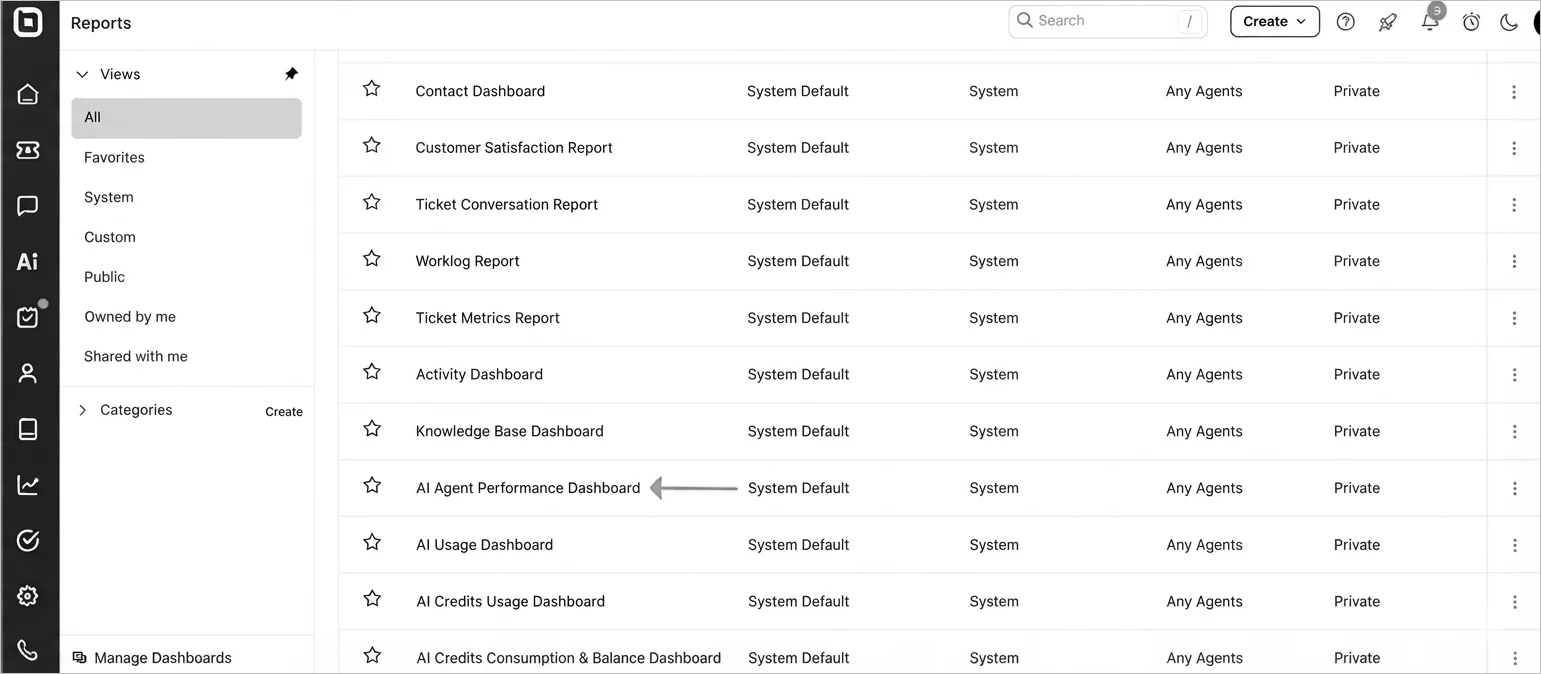
For example, the BoldDesk AI agent performance dashboard brings metrics such as deflection rate, escalation rate, human hours saved, and handling type into one view. This makes it easier to spot trends and track performance over time.
Since deflection rate includes abandoned conversations, it should be interpreted alongside other resolution metrics.
Turn AI agent support metrics into better customer service outcomes
Measuring AI agent performance goes beyond automation rates and response times. Organizations need to understand whether AI is solving customer issues, delivering accurate answers, and creating better experiences.
The metrics in this guide provide that insight. Together, they show what’s working and where improvements are needed. Support teams can use them to improve AI performance, enhance customer outcomes, and scale automation with confidence.
With BoldDesk, you can track the metrics that matter, see how your AI agent performs, and find ways to improve service and cut costs.
Start your free trial today and see how better data can improve your AI customer support.
Related articles
- 12 Best AI Agents for Scalable Customer Support
- Ticket Deflection: A Smart Strategy for Efficient Customer Support
- AI Agents in Customer Service: How They Work and What They Resolve
FAQs
Containment rate measures conversations that stay within the AI experience, while automated resolution rate measures issues fully resolved by AI. A conversation can be contained without successfully resolving the customer’s problem.
A good AI resolution rate depends on your support environment and AI maturity. Most organizations focus on improving resolution rates over time rather than targeting a fixed benchmark.
AI hallucinations are measured by calculating the percentage of responses that contain inaccurate, misleading, or fabricated information. Organizations typically validate responses through QA reviews, audits, and comparisons against approved knowledge sources.
Organizations commonly track FCR, automated resolution rate, containment rate, answer accuracy, hallucination rate, CSAT, CES, repeat contact rate, and cost per resolution to evaluate overall AI performance.
FCR is one of the metrics most closely linked to CSAT. Customers value quick, successful answers. Higher FCR rates often correlate with improved CSAT and fewer repeat contacts.
No single metric provides a complete view of AI performance. Tracking multiple metrics together helps organizations identify whether automation is producing successful customer outcomes.