


TL;DR: AI is transforming banking and fintech customer support, but regulators expect more than automation. Financial institutions must ensure transparency, human oversight, data protection, security, and accountability to use AI responsibly, manage compliance risks, and maintain customer trust.
An AI assistant can answer a balance question in seconds. But what happens when a customer reports a suspicious transaction or shares sensitive information?
In those situations, speed alone isn’t enough. Customers need to know their data is protected and that a human agent can step in when needed.
Financial organizations need clear rules for how AI uses customer information. They also need a safe way to escalate sensitive questions AI cannot resolve.
This guide explains what regulators expect from AI in banking and fintech support. It also shows how to reduce compliance risks and oversee AI responsibly.
What is AI in banking and fintech support?
AI in banking and fintech support uses artificial intelligence to automate and assist customer service interactions in banking and financial services.
It can help with account questions, transaction updates, onboarding, and payment inquiries. Sensitive requests still need strong security controls and human oversight.
Why AI adoption in banking and fintech support is attracting regulatory attention
AI adoption is accelerating as banks and fintech companies invest in technologies that improve service efficiency and customer experience.
According to NVIDIA’s 2026 State of AI in Financial Services report, 61% of financial services respondents were using or assessing generative AI in 2025. That’s up from 52% the year before.
As adoption grows and AI takes on a larger role in day-to-day banking and support interactions, supervisory authorities are paying closer attention to how these systems operate.
Unlike many other industries, financial services deal with sensitive customer data, financial transactions, fraud risks, and strict consumer protection requirements.
Errors such as inaccurate account information or failed escalations can cause complaints and financial harm. They can also attract regulatory attention and damage an organization’s reputation.
As a result, regulators are increasingly focused on ensuring that AI systems are:
- Transparent
- Secure
- Accountable
- Subject to defined human oversight
Financial institutions should be able to show that AI improves customer service in banking while maintaining security, compliance, and customer trust.
What regulators expect from AI-powered banking and fintech customer support
Regulatory approaches differ. Common concerns include customer protection, privacy, security, fairness, and accountability.
Some rules also depend on what an AI system is used for and the risks it may pose.
Below are key expectations financial institutions should address before deploying AI in fintech customer service.
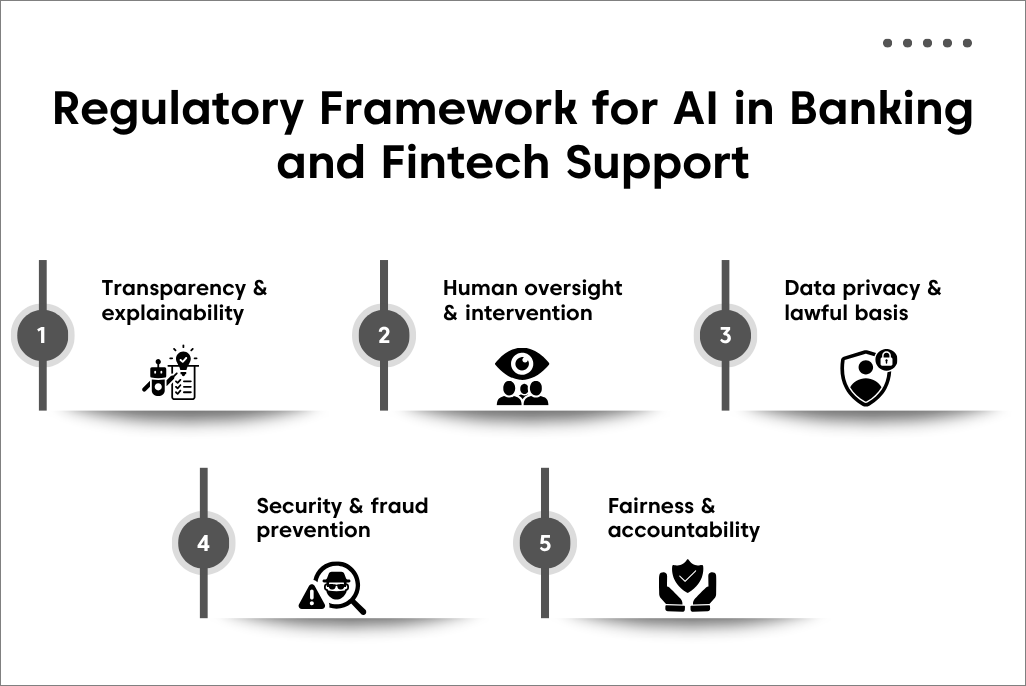
Transparency and clear explanations
Customers should be informed when they are interacting with AI and receive clear, accurate information.
If an AI-generated response involves a complaint, dispute, or other sensitive matter, the organization should also be able to explain how it produced the response.
Clear records of AI interactions, knowledge sources, and escalation decisions can help support customer inquiries, internal reviews, and regulatory examinations.
Human oversight and intervention
AI in banking should not operate without appropriate supervision. An AI-to-human handoff should be triggered when interactions are high risk, complex, or beyond the AI’s capabilities.
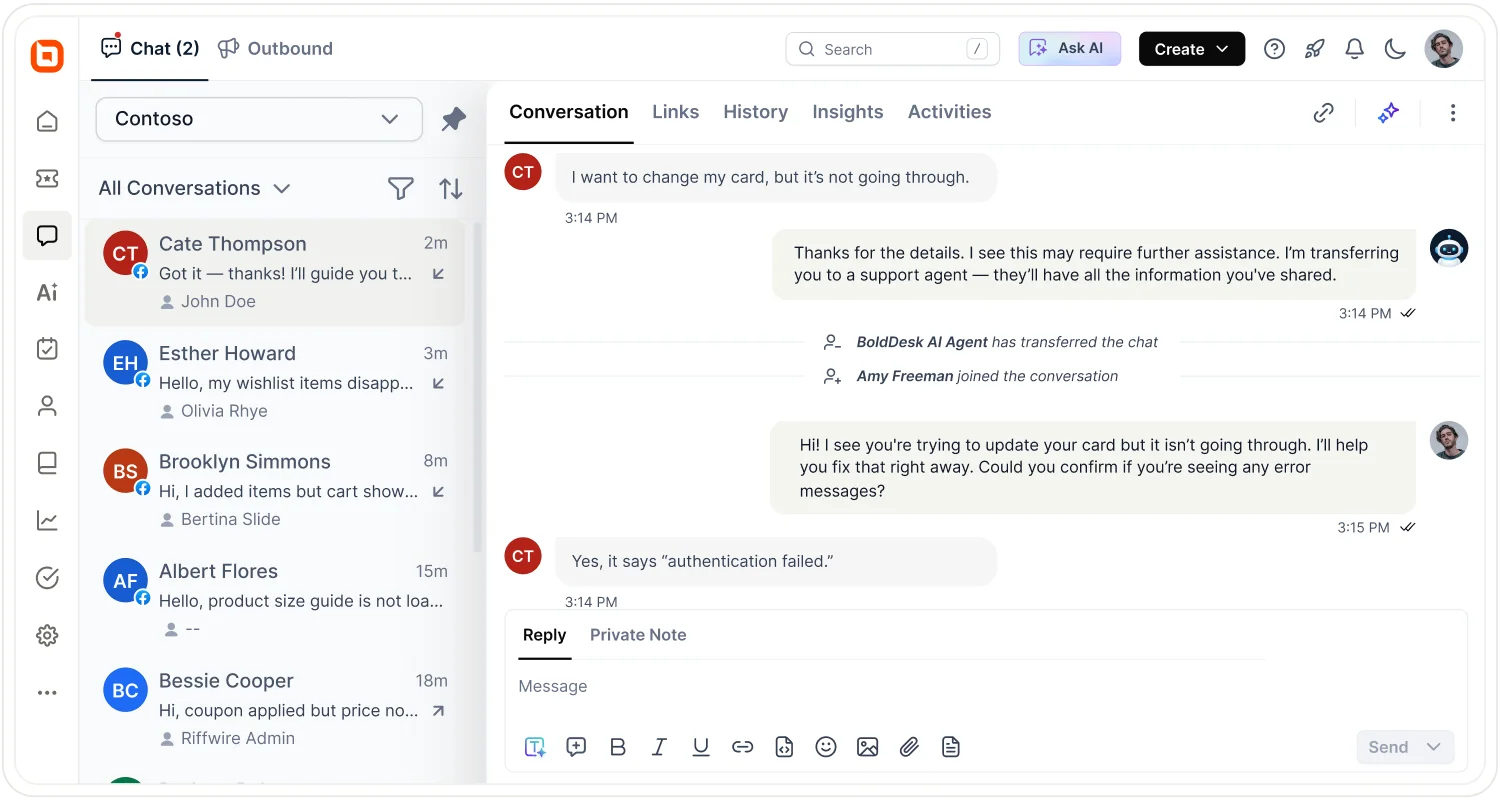
Support teams should be able to review interactions, correct responses, and make final decisions when necessary. This helps maintain accuracy, accountability, and regulatory compliance.
Data privacy and lawful basis
Customer support interactions often involve personal and financial information.
Financial institutions must ensure customer data is processed under applicable privacy laws and used only for authorized support purposes.
AI systems should access only the data needed to complete a task. Data should also be protected by appropriate security and access controls.
Security and fraud prevention
AI support systems can be targeted by cyberattacks, data theft, and fraud attempts.
Organizations should implement strong authentication, access controls, monitoring, and incident-response processes.
This is particularly important when AI handles:
- Account access
- Identity verification
- Profile updates
- Payment-related inquiries
These safeguards help support effective customer data management and reduce fraud risks.
Fairness, bias monitoring, and accountability
Financial institutions should regularly test AI for inaccurate answers and unfair outcome differences across customer groups.
Assign a person to review the results and address problems. If a vendor provides the AI model, the financial institution remains responsible for how it is used and for its customer outcomes.
Vendor oversight
Many banks rely on third-party AI vendors. Check each vendor’s security, data handling, retention, model updates, and subcontractors. Keep records of these reviews.
Teams should also review AI support vendor questions about pricing, usage limits, and contract costs.
The table below provides a simplified overview of what regulators expect from AI in banking and fintech support.
| Regulatory expectation | Operational control | Evidence to retain |
| AI transparency | Tell customers when they are interacting with AI | Interface copy and usage records |
| Accurate information | Ground answers in approved, version-controlled sources | Knowledge version and response logs |
| Human intervention | Define triggers for complaints, disputes, fraud, and low confidence | Escalation rules and handoff records |
| Use only necessary data | Restrict each workflow to required customer data | Access matrix and data-flow map |
| Fair customer results | Test outputs across customer groups and languages | Test results and corrective action records |
| Vendor oversight | Review sub-processors, data use, retention, and model changes | Vendor assessment and contract records |
Key EU, UK, and U.S. rules influencing AI customer support in banking
Regulations affecting AI in banking and fintech support vary by jurisdiction and may depend on where an institution operates, serves customers, or processes data.
Common priorities include privacy, security, transparency, risk management, accountability, and consumer protection.
The sections below cover key regulations that may apply to AI customer support in banking.
EU AI Act: Transparency and risk categories
The EU AI Act uses a risk-based framework. Since August 2, 2026, Article 50 transparency requirements have applied to certain interactive AI systems. This includes obligations to inform users when they are interacting with AI in defined circumstances.
General customer-support AI chatbots are not automatically classified as high-risk. AI used to assess creditworthiness, or someone’s ability to repay a loan, may face extra requirements.
Under the EU AI Act, many high-risk systems listed in Annex III must comply by December 2, 2027.
Financial institutions should: Assess each AI use case separately. Consider what it does, who it affects, what harm an error could cause, and whether disclosure or high-risk requirements apply.
GDPR: Personal data and privacy
The General Data Protection Regulation (GDPR) sets rules for using personal data. In customer support, that data may include chat records, account details, and transaction questions.
Organizations need a valid legal reason to use customer data. The GDPR calls this a “lawful basis.” They must also explain how they use the data, collect only what they need, protect it, and respect customers’ rights.
Financial institutions should: Record the purpose and lawful basis for each AI workflow. Limit the data the system can access, set rules for how long to keep it, and explain data use to customers in clear language.
FCA rules: Consumer outcomes and accountability
The Financial Conduct Authority (FCA) has not introduced AI-specific rules. Instead, existing requirements such as the Consumer Duty and the Senior Managers and Certification Regime apply when regulated firms use AI.
Financial institutions should: Ensure that AI supports customer needs without creating barriers, misleading customers, or causing unfair treatment. Set clear escalation paths and monitor results.
U.S. federal banking agencies: Model risk guidance
In April 2026, the Federal Reserve, the Office of the Comptroller of the Currency, and the Federal Deposit Insurance Corporation issued SR 26-2 / OCC Bulletin 2026-13. The guidance replaced earlier frameworks, including SR 11-7 and SR 21-8.
The guidance is supervisory, not an enforceable rule. It excludes generative and agentic AI. The agencies have also announced plans to seek public input on model risk and banks’ use of AI, including these systems.
Financial institutions should: Check whether the guidance applies to their organization and models. For generative or agentic AI, which the guidance excludes, assess the systems’ risks and set appropriate controls, oversight, and testing.
GLBA and Regulation E: Consumer protection and data security
In the United States, the Gramm-Leach-Bliley Act (GLBA) and Regulation E establish requirements for protecting customer information and handling electronic funds transfer disputes.
These obligations may be particularly relevant when AI assists with transaction inquiries, disputed payments, account-related questions, or other customer-facing support interactions.
Financial institutions should: Protect customer data and verify identity before sharing account details. Ensure AI recognizes payment disputes and passes them to the right team without delay. Track applicable investigation and response deadlines.
Common compliance risks of AI in banking and fintech support
AI can help financial companies, but it can also create risks. Poorly managed systems may lead to regulator reviews, customer complaints, or damage to a company’s reputation.
Understanding these risks is the first step toward building compliant AI in fintech support operations.
- AI hallucinations and inaccurate financial information: AI in fintech can generate responses that sound convincing but contain inaccurate information about products, transactions, or policies. In financial services, even small inaccuracies can cause customer harm, complaints, or regulatory attention.
- Unauthorized advice and regulatory exposure: AI in banking and finance should not provide personalized financial advice unless specifically approved. Responses that influence investment, lending, or financial decisions may create regulatory and legal risks.
- Customer identity verification failures: Support interactions often involve sensitive account details. Weak identity checks can let the wrong person into an account or expose customer data.
- Data leakage and privacy violations: Customer information may be exposed through integrations, prompts, training data, or configuration errors. Financial institutions must protect confidential data throughout the AI lifecycle.
- Inadequate audit trails: Keep records of AI replies, approvals, and handoffs. Without them, teams may struggle to review incidents or answer regulators’ questions.
- Prompt injection and AI manipulation: Harmful instructions in a message or source document can try to make AI ignore its rules. Test whether these attacks can expose data or trigger unauthorized actions.
- Vulnerable customers and accessibility: AI support experiences should remain accessible and inclusive. Human assistance should be available when customers need additional support or automated systems cannot resolve their issue.
In regulated industries, inaccurate AI responses are not just customer service problems. They can become risk and compliance concerns.
Banks and fintech companies need clear AI rules, trusted sources, and escalation management processes. These controls help prevent mistakes and limit harm.
What AI should and should not handle in financial customer support
Not every customer request is suitable for automation. AI can answer routine questions, while sensitive or high-risk issues need human review.
In its 2023 report, the Consumer Financial Protection Bureau (CFPB) described chatbot “doom loops.” Customers receive repeated, unhelpful answers with no clear route to a human agent.
The table below shows where AI can help, what safeguards to use, and when a human should step in.
| AI can handle or assist with | Safeguard | Human should handle |
| FAQs, published product information, and general eligibility rules | Use approved, current sources. Don’t make individual qualification decisions. | Personalized financial advice or recommendations. Refer customers to a qualified adviser when needed. |
| General password and login guidance | Verify identity before providing account-specific help or making account changes. | Account access problems that need investigation. |
| View-only account balances and transaction details | Authenticate customers, limit access to viewing information, and record account access. | Disputed transactions, suspected fraud, and fraud investigations. |
| Onboarding steps and document-status updates | Use verified status information. Don’t make lending or credit decisions. | Individual lending and credit decisions. |
| Routing requests to the right team | Set clear handoff triggers and pass the conversation history to the next team. | Formal complaints and unusual, sensitive, or high-risk cases. |
Examples from financial services:
Wells Fargo (Banking)
Wells Fargo’s virtual assistant, Fargo, helps customers with common banking tasks such as sending money with Zelle, paying bills, checking account balances, and tracking spending.
Since its 2023 launch, Fargo has handled more than 1 billion customer interactions.
Nubank (Fintech)
Nubank uses AI to summarize conversations and help agents find relevant information. According to OpenAI, Nubank’s assistant resolves about 55% of routine, first-level questions. It handles over two million chats monthly and cuts chat response times by 70%.
If the issue is not resolved within five automated exchanges, the conversation can be transferred to a human agent.
Building a compliant AI in banking and finance support strategy
Compliance should be part of AI planning from the start. Clear ownership, security controls, and review processes help teams manage risks as they adopt AI.
A structured approach helps reduce risk and supports long-term AI adoption.
Establish governance policies
Develop clear policies that define acceptable AI in banking use cases, accountability structures, AI risk management procedures, and escalation requirements.
Also assign owners for AI oversight and establish a regular review schedule to assess risks, performance, and compliance as business and regulatory requirements evolve.
Use verified knowledge sources
AI should generate responses from trusted, approved, and regularly updated knowledge sources.
Organizations should establish processes to approve content, review it for accuracy, update it when information changes, and retire outdated resources.
This reduces misinformation, improves response consistency, and supports regulatory compliance.
Implement human-in-the-loop workflows
Effective human-in-the-loop workflows ensure that AI can seamlessly transfer complex or unresolved cases to human agents.
To support smooth handoffs, organizations should pass conversation history, relevant customer context, and completed actions to the receiving team.
Clear routing rules and regular testing help ensure handoffs work as intended and customers receive consistent support without repeating information.
Continuously monitor AI performance
Measure AI performance regularly to identify inaccuracies, compliance issues, security concerns, and customer experience gaps before they escalate.
Track response accuracy, errors, failed handoffs, complaints, escalations, and resolution outcomes. Compare results across different customer groups.
Create regulatory audit readiness
Keep records that show how you manage AI. These include policies, risk reviews, approvals, test results, monitoring logs, audit trails, security incidents, and fixes.
Well-maintained records help support regulatory reviews, investigations, and ongoing compliance efforts.
Download this practical checklist to evaluate whether your AI-powered customer support strategy includes the governance, security, oversight, and compliance controls regulators commonly expect.
While it does not guarantee compliance, it can help support a stronger AI governance and risk-management program.
Balancing AI in banking and fintech support with regulatory compliance
Before expanding AI in fintech support, map what each workflow can access, what it can do, and when a person should take over.
Review these boundaries whenever the AI system, customer data, or support process changes.
BoldDesk supports these efforts with AI-powered support, workflow automation, audit logs, role-based access controls, and human escalation workflows.
Fintech teams can also explore BoldDesk’s help desk software for fintech to support customer service operations in regulated environments.
Ready to balance automation with compliance requirements? Sign up for a 15-day free trial of BoldDesk today to explore AI-assisted customer support. No credit card required.
Related articles
- 4 Common Phishing Attacks and How to Prevent Them
- AI Agent Autonomy Levels: 5 Stages and When to Use Each
- 7 AI Customer Support Implementation Mistakes and How to Fix Them
FAQs
Yes. Banks and fintech companies can use AI for routine support. It can answer common questions, help with onboarding, route requests, and show approved account or transaction details.
However, AI in banking deployments should include appropriate security controls, governance policies, and human oversight to support regulatory and compliance requirements.
Depending on the market, relevant rules include the EU AI Act, GDPR, GLBA, Regulation E, and the FCA’s Consumer Duty. Check which apply to your products, customers, and AI tasks.
Common risks include inaccurate or misleading responses, privacy violations, data leakage, weak identity verification processes, inadequate oversight, and insufficient audit records.
If left unmanaged, these issues can attract regulatory attention and erode customer trust.
Most general customer-support chatbots are not automatically considered high-risk under the EU AI Act. However, they may still be subject to transparency requirements. AI used for creditworthiness assessments or other consequential decisions may face stricter obligations.
Banks can improve compliance by setting clear AI policies, using trusted sources, and defining when staff must review a case. Keep records and regularly test answers, security, and compliance.
Banks should evaluate an AI support provider’s security controls, data-handling practices, access permissions, audit logs, system integrations, human-oversight features, and relevant independent assurance.
Relevant evidence may include a SOC 2 Type II report or ISO 27001 or ISO 42001 certification. Check PCI DSS requirements where payment card data is involved.