



TL;DR: AI customer service by industry is the practice of tailoring AI-powered support to an industry’s ticket types, compliance requirements, and customer expectations. Healthcare, financial services, insurance, SaaS, retail, telecom, HR, and transport and logistics require different automation strategies, with repetitive requests best automated and complex decisions left to human experts.
Not long ago, “AI customer service” meant a chatbot that misread your question, gave a generic answer, and pushed you toward a human anyway. Today, the bigger question isn’t whether AI can answer a customer question, but where it can do so safely and effectively.
The reality is that not every AI mistake has the same consequences. In 2024, Air Canada was held liable after its chatbot provided incorrect bereavement fare information to a customer, showing how the risks of customer-facing AI can vary depending on the situation.
That’s why AI customer service by industry can’t follow a single playbook. Automating order tracking for a retailer carries far less risk than handling patient information in healthcare or verifying customer identity in financial services.
When the cost of getting it wrong is higher, human oversight and effective AI-to-human handoffs become just as important as automation itself.
This guide explores AI customer service by industry, including healthcare, financial services, insurance, SaaS, retail, telecom, HR, and transport and logistics. For each sector, we’ll look at common support requests, compliance considerations, and the role risk plays in automation decisions.
Why AI customer service looks different across industries
Many organizations start their AI customer service journey by asking what tasks they can automate. A better question is what responsibility comes with each customer interaction.
Several factors determine where customer service automation by industry makes sense:
- Customer requests: Some interactions simply require information, while others require recommendations, exceptions, approvals, or dispute resolution.
- Compliance obligations: Privacy, security, recordkeeping, and disclosure requirements influence how customer data can be accessed, processed, and shared.
- Business risk: The consequences of an inaccurate response vary significantly by industry. An incorrect delivery update carries a different level of risk than an incorrect healthcare recommendation, lending decision, or coverage explanation.
- Human expertise: Some situations require investigation, negotiation, discretion, or professional judgment that cannot be standardized.
Across major sectors, the same pattern appears repeatedly: customer service automation primarily focuses on access to information before automating decisions.
That’s why healthcare teams focus on administrative support, financial institutions prioritize servicing and verification, insurers streamline claims and policy communications, SaaS companies invest heavily in customer self-service and onboarding, and retailers automate post-purchase support.
Note: Examples in this guide reference widely recognized U.S. frameworks such as HIPAA, PCI DSS, CPNI, FMLA, and ADA. Organizations operating internationally should also consider regulations such as GDPR, local privacy laws, and the EU AI Act when deploying customer-facing AI.
AI customer service in healthcare
In healthcare, the support challenge is not simply responding faster. It’s improving access to care without compromising patient privacy, trust, or clinical accuracy.
According to McKinsey & Company, 62% of healthcare leaders identified consumer engagement and experience as the area where generative AI has the greatest potential, highlighting growing interest in AI-powered patient service and support operations.
| Common ticket types | Why patients contact support |
| Appointment scheduling and rescheduling | Book, change, cancel, or confirm appointments |
| Patient portal access | Resolve login, password, or account access issues |
| Billing and payment inquiries | Understand charges, balances, or payment options |
| Insurance verification | Confirm coverage, eligibility, or authorization requirements |
| Prescription refill requests | Request medication renewals or status updates |
| Medical records requests | Obtain, transfer, or access health records |
| General service inquiries | Ask about office hours, locations, providers, or available services |
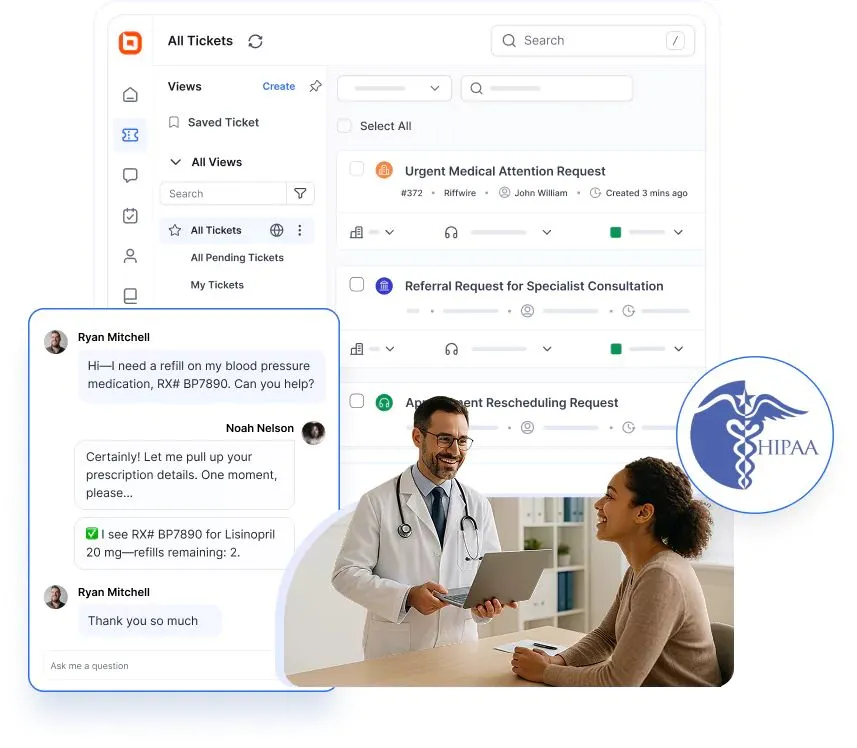
Compliance considerations: AI systems handling patient data must comply with HIPAA’s privacy and security rules, including the Minimum Necessary Standard and patient identity verification before disclosing PHI. If a vendor accesses PHI on your behalf, a signed Business Associate Agreement (BAA) is required.
What to automate first: The strongest automation candidates are portal access, appointment scheduling, and billing or insurance-verification status checks that are routine, repetitive, and low risk. Anything involving clinical guidance, care decisions, or vulnerable patients should remain with clinical and support staff.
A dedicated help desk for healthcare can route these automatically while keeping sensitive interactions with your team.
The business impact is becoming increasingly clear. NVIDIA’s 2026 State of AI in Healthcare and Life Sciences found that 80% of healthcare and life sciences organizations reported lower annual costs from AI initiatives, while 85% reported increased annual revenue.
Learn how to implement AI customer service in healthcare while meeting compliance requirements.
Real-world example: MediBuddy
By using AI-powered chat and self-service tools to automate routine inquiries, MediBuddy increased its customer satisfaction score to more than 90%, according to the company’s Verloop case study.
AI customer service in financial services
For customer service in banking, customers expect fast support for account access, transactions, and fraud-related concerns while maintaining trust and security.
AI customer service helps banks meet these expectations while lowering support costs and scaling service delivery, creating measurable business value alongside a better customer experience.
NVIDIA’s 2026 State of AI in Financial Services found that 89% of respondents said AI is helping increase annual revenue and decrease annual costs, highlighting its growing impact across customer service and operational workflows.
| Common ticket types | Why customers contact support |
| Account balances and transaction inquiries | Review balances, pending transactions, or account activity |
| Online and mobile banking support | Resolve login issues, authentication failures, or account lockouts |
| Card management requests | Activate, replace, freeze, or report lost and stolen cards |
| Payment and transfer inquiries | Check the status of transfers, bill payments, or wire transactions |
| Fraud and suspicious activity reports | Report unauthorized transactions or potential account compromise |
| Loan and credit application updates | Track application progress and review next steps |
| Disputes and chargebacks | Challenge transactions or request investigations |
| Product and account inquiries | Understand fees, rates, eligibility requirements, and account features |
Compliance considerations: AI customer service in the finance industry must protect cardholder data under PCI DSS (Payment Card Industry Data Security Standard) and support KYC/AML (Know Your Customer/Anti-Money Laundering) identity and activity checks before account actions proceed. Customer interactions often need to be retained for audit and regulatory review.
What to automate first: Balance inquiries, card management, and transfer status checks are easy to automate because they’re common and low risk. However, these interactions should only proceed after appropriate customer authentication and identity verification controls are completed.
Fraud reports, disputes, and lending decisions should be handled by humans because mistakes can have immediate financial consequences.
A finance help desk can automatically route these requests to the right channel while maintaining the appropriate level of human oversight.
Real-world example: Bank of America (Erica)
Bank of America’s Erica helps customers check balances, review transactions, manage cards, track spending, and find answers to common banking questions directly through the mobile app. The bank also uses AI-assisted tools to support service representatives with real-time guidance while keeping employees involved in customer interactions.
AI customer service in insurance
Most insurance interactions begin with uncertainty, as customers seek quick answers about coverage, claims, and policy changes.
To improve these experiences, insurers are increasingly shifting from back-office AI initiatives to customer-facing applications such as customer service chatbots and automated onboarding, according to an EY survey.
McKinsey & Company estimates that generative AI could unlock $50 billion to $70 billion in annual value for the insurance industry, with customer operations among the largest opportunity areas.
| Common ticket types | Why policyholders contact support |
| Coverage and policy questions | Questions about policy limits, exclusions, deductibles, and covered events |
| Claims status updates | Checking claim progress, required documents, settlement timelines, or next steps |
| Policy changes | Updating beneficiaries, personal details, coverage levels, or insured assets |
| Billing and renewals | Premium payments, billing questions, renewal notices, and payment confirmations |
| Claims initiation (FNOL) | Reporting an incident and receiving guidance on the claims process |
| Document submission and retrieval | Uploading, verifying, retrieving, or submitting policy and claims documentation |
Compliance considerations: Insurance interactions often become part of a claim file or audit trail, so policyholder data privacy, identity verification, and accurate recordkeeping are non-negotiable. Fraud detection and investigation processes add another layer of scrutiny to how AI can be used.
What to automate first: Claims status updates, billing inquiries, document retrieval, policy changes, and routine FNOL intake are strong automation candidates. FNOL should be escalated when injuries, safety concerns, emergencies, or high-severity losses are reported.
A dedicated help desk for insurance can automatically route each request to the right team without manual triage.
Real-world example: Lemonade
Lemonade uses AI to handle parts of the claims journey, including claim intake, status updates, and claims processing for eligible cases. When higher-risk situations arise, claims are escalated to human teams, demonstrating how insurers balance automation with oversight.
AI customer service in SaaS
As SaaS companies scale, AI is increasingly being used to help customers find answers faster and stay productive without disrupting their workflow.
According to Salesforce’s Seventh Edition State of Service Report, 95% of organizations using AI report cost and time savings, highlighting how AI is becoming a practical tool for improving customer service efficiency at scale.
| Common ticket types | Why users contact support |
| Account access and authentication | Login failures, password resets, SSO issues, and multi-factor authentication problems |
| Product troubleshooting | Features not working as expected, performance issues, bugs, or unexpected behavior |
| Onboarding and implementation support | Help with setup, configuration, data migration, and initial product rollout |
| Billing and subscription management | Questions about invoices, renewals, upgrades, usage limits, or cancellations |
| Feature adoption and product guidance | Help understanding how to use specific features and workflows effectively |
| Integration and API support | Connecting the platform with third-party applications, tools, and data sources |
| User and permission management | Managing roles, access controls, team settings, and user permissions |
Compliance considerations: Customer data in SaaS support must be handled under GDPR/CCPA and any contractual data-processing agreements, with role-based access limiting who and what can see it. SOC 2 or ISO 27001 alignment and audit logging are typically expected by enterprise customers.
What to automate first: Password resets, billing questions, and common feature how-to requests are great candidates for automation because they’re straightforward and follow predictable workflows.
More complex technical issues, security incidents, and unique enterprise requirements should be escalated to experienced support teams.
This allows support teams to reduce repetitive work while using a help desk for SaaS to keep complex technical issues in the hands of the right experts. Learn how to scale customer support effectively with our guide on AI support for B2B SaaS.
Real-world example: GitHub
GitHub introduced an AI-powered assistant in its support portal to help customers resolve routine product and support inquiries. According to GitHub, the assistant resolved 60% of cases presented to it, with most completed in under seven minutes.
AI customer service in retail and ecommerce
Retail customers often contact support because information exists but is difficult to access, making visibility a larger issue than resolution.
These questions create a constant stream of post-purchase interactions, making retail and ecommerce some of the earliest adopters of customer service automation.
| Common ticket types | Why customers contact support |
| Order tracking (WISMO) | Checking order status, shipment progress, delivery dates, or tracking updates |
| Delivery support | Address changes, delivery delays, missing packages, or proof of delivery requests |
| Returns and exchanges | Return eligibility, exchange requests, return instructions, and return status updates |
| Refund inquiries | Refund approval status, processing timelines, and reimbursement confirmations |
| Product questions | Stock availability, sizing guidance, product specifications, and compatibility checks |
| Payment and checkout support | Failed payments, billing issues, discount application problems, or payment verification |
| Loyalty and rewards support | Reward balances, points redemption, promotional offers, and discount code issues |
Compliance considerations: Retail AI support must protect payment data under PCI DSS and handle customer data per GDPR/CCPA, including consent rules for marketing communications. Order and account changes typically require identity verification first.
What to automate first: Order tracking, delivery updates, and standard returns are ideal for automation because they’re common and straightforward. Support agents should handle high-value refunds, disputed claims, and fraud-related cases.
This allows teams to speed up everyday support while using an ecommerce help desk to handle exceptions more effectively.

Real-world example: Alibaba
Alibaba uses AI chatbots to handle more than two million customer service sessions each day across its ecommerce platforms. The company reports that the chatbots handle about 75% of online consultations and increased customer satisfaction by 25%.
AI customer service in telecom
Telecom support volume is driven by two things at once: billing questions from a huge subscriber base and connectivity issues that customers experience as urgent even when they’re minor.
That mix is what makes ticket triage harder here than in most industries.
NVIDIA’s 2026 State of AI in Telecommunications report found that 90% of telecom operators said AI is helping increase annual revenue and reduce costs, while customer service was the second-most cited source of AI ROI (41%), behind network automation.
| Common ticket types | Why customers contact support |
| Billing and plan inquiries | Understand charges, dispute fees, or compare plan options |
| Network and service issues | Report outages, dead zones, slow speeds, or dropped connections |
| Device and technical support | Troubleshoot handset, router, SIM, or eSIM setup issues |
| Account and number management | Port numbers, activate or cancel lines, update account details |
| Upgrades and plan changes | Add lines, change plans, or upgrade devices |
| Fraud and security concerns | Report SIM swaps, unauthorized charges, or account takeover attempts |
Compliance considerations: Telecom accounts and call data are protected under CPNI (Customer Proprietary Network Information) rules, requiring identity verification before disclosure. Number porting and service changes also carry regulatory timelines that AI workflows need to respect.
What to automate first: Bill explanations, outage status updates, plan changes, and common troubleshooting requests are good candidates for automation because they follow established workflows. Persistent connectivity issues, fraud reports, SIM-swap concerns, and account changes involving protected customer data should be escalated to support agents.
Getting this balance right is easier with help desk software for telecom that can help distinguish between routine service requests and higher-risk account issues.
Real-world example: Elisa
Telecommunications provider Elisa, working with MindTitan, deployed an AI customer service bot called Annika to handle routine support inquiries at scale.
According to the company’s case study, the bot handles up to 70% of inbound contacts and automatically resolves 34% of all customer inquiries, helping customers receive faster support while reducing pressure on service teams.
AI customer service in HR and employee support
A large share of HR support requests are routine, from checking leave balances and benefits eligibility to finding policy information or onboarding resources.
AI helps employees get these answers when they need them instead of waiting for HR to respond, while HR teams can focus on issues that require context, confidentiality, or personal guidance.
| Common HR request types | Why employees contact HR |
| Benefits and enrollment questions | Understand health insurance options, enrollment windows, or plan changes |
| PTO and leave requests | Check leave balances, request time off, or ask about FMLA and parental leave |
| Payroll and compensation inquiries | Resolve paycheck discrepancies, tax withholding, or direct deposit changes |
| Onboarding and offboarding support | Complete new-hire paperwork, request equipment and system access, or process an exit |
| Policy and compliance questions | Clarify company policy, code of conduct, or workplace procedures |
| IT and systems access requests | Reset passwords or request software, hardware, or access changes |
Compliance considerations: Leave requests touching FMLA or ADA, and any employee data handling must meet applicable labor and privacy regulations, including GDPR/CCPA where relevant. AI should never make or influence decisions involving compensation, discipline, or accommodations without human review.
What to automate first: Benefits questions, PTO balance checks, and standard onboarding tasks are the best starting points for automation because they’re common and follow established processes.
HR professionals should handle leave requests involving FMLA or ADA accommodations, harassment or discrimination complaints, and compensation disputes because they involve sensitive situations and potential legal considerations.
Explore our guide on AI agents for HR and employee support for a closer look at how organizations are using AI to improve HR support.
Real-world example: IBM AskHR
IBM uses AskHR, an AI-powered HR assistant, to provide employees with 24/7 support for common questions and routine HR transactions.
The platform helps employees quickly access information and complete tasks through self-service, allowing HR teams to spend more time on strategic and complex employee issues.
AI customer service in transport and logistics
Most logistics support requests happen because customers want to know where a shipment is and when it will arrive.
Visibility and responsive service have become key priorities in logistics.
A BCG survey of more than 180 logistics providers and shippers found that over 40% of shippers now consider a provider’s AI capabilities when selecting partners.
Yet fewer than 10% treat AI as a mandatory requirement, and only about one in ten providers have scaled AI across core operations.
| Common transport and logistics ticket types | Why customers contact support |
| Shipment tracking and status | Checking current location, transit progress, or estimated arrival |
| Delivery exceptions | Delays, missed delivery windows, or damaged-goods reports |
| Customs and documentation | Requesting commercial invoices, certificates of origin, or resolving customs holds |
| Booking and rate inquiries | Requesting quotes or checking capacity availability |
| Claims for lost or damaged freight | Filing and tracking claims for missing or damaged shipments |
| Proof of delivery requests | Retrieving signed delivery confirmation or shipment documentation |
Compliance considerations: Customs documentation and hazardous-materials shipments carry strict regulatory accuracy requirements, so AI-assisted responses here need human review before anything is finalized. Shipment and recipient data also fall under standard data-privacy rules like GDPR/CCPA.
What to automate first: Shipment tracking, delivery updates, estimated arrival times, and document requests are strong automation candidates because they rely on readily available information and follow predictable resolution paths.
Customs delays, damaged shipments, and requests involving hazardous goods should be handled by a person because the consequences of getting them wrong can extend beyond customer support.
Not every shipment issue needs the same level of support, which is why many teams rely on a help desk for logistics and transport to handle routine inquiries efficiently while escalating more complex cases.
Real-world example: DHL
DHL Global Forwarding added a generative AI virtual assistant to its myDHLi customer portal, providing 24/7 access to shipment status, customs declaration visibility, and support resources.
The platform serves more than 20,000 customers and tracks over 450,000 shipments each month.
AI customer service priorities by industry
Customer expectations, regulatory requirements, and the consequences of errors vary widely across industries, which is why automation priorities differ from one sector to another.
The table below highlights those differences in depth.
| Industry | What drives customer service demand? | Biggest risk of over-automation | Where AI customer service delivers value |
| Healthcare | Helping patients access care and navigate administrative processes. | Inaccurate handling of protected health information or interactions that drift into clinical guidance. | Reducing administrative workload through scheduling, intake, reminders, and patient self-service. |
| Financial services | Maintaining account access and supporting transaction-related activities. | Security failures, fraud exposure, and incorrect handling of sensitive financial information. | Accelerating routine account servicing while maintaining strong verification controls. |
| Insurance | Supporting policyholders through claims, policy servicing, and coverage-related inquiries. | Incorrect policy interpretation, claims handling errors, or disputes arising from inaccurate information. | Providing visibility into claim progress and reducing friction throughout the policy lifecycle. |
| SaaS | Helping users successfully adopt and use software products. | Poor guidance that slows adoption, increases frustration, or contributes to customer churn. | Accelerating onboarding, product adoption, and user self-service throughout the customer lifecycle. |
| Retail and ecommerce | Managing high volumes of post-purchase inquiries. | Frustrating customers with poor issue resolution during returns, refunds, or delivery exceptions. | Handling repetitive requests such as order tracking, returns, refunds, and delivery updates at scale. |
| Telecom | Resolving billing, service, and connectivity issues across large subscriber bases. | Mishandling CPNI-protected account or call data, or disclosing details without identity verification. | Reducing wait times for high-volume billing, plan-change, and troubleshooting requests. |
| HR and employee support | Answering internal employee questions about benefits, leave, payroll, and policy. | Mishandling FMLA/ADA accommodation requests, harassment complaints, or compensation disputes without human review. | Automating benefits, PTO, and onboarding questions so HR can focus on higher-judgment work. |
| Transport and logistics | Providing visibility into shipment status and resolving delivery exceptions. | Errors in customs documentation or hazardous-materials handling that create regulatory or safety exposure. | Automating shipment tracking, ETAs, and document retrieval at scale. |
What stands out is that each industry is trying to solve a different business problem. These differences explain why copying another industry’s AI customer service strategy rarely works.
The most successful deployments are designed around the underlying customer need, the level of risk involved, and the business outcome the organization is trying to improve.
Create effective AI customer service for your industry
The industries discussed in this guide are adopting many of the same AI customer service technologies, but they’re solving very different problems.
Healthcare organizations focus on access and administration. Financial institutions prioritize verification and security. Insurers streamline policy and claims communications. SaaS companies accelerate onboarding and product adoption. Retailers reduce post-purchase friction.
Telecom providers manage high volumes of billing and connectivity requests. HR teams automate routine employee support. Logistics organizations improve shipment visibility and status communication.
Understanding those differences is often the deciding factor between successful AI customer service deployments and costly automation initiatives that fail to deliver meaningful value.
BoldDesk combines AI, self-service, ticket management, and human support in one platform. It also includes the security controls and audit trails regulated industries need to support compliance programs.
Start your free trial today and build an AI customer service strategy that matches the needs of your industry.
Related articles
- AI Support for B2B SaaS Without Hallucinations | BoldDesk
- AI Agent for IT Support: What’s Different from CX?
- AI Agents for Ecommerce: Increase Revenue in 6 Months
FAQs
Industries with high volumes of repetitive, information-based requests typically benefit the most from AI customer service. Common examples include retail, telecom, SaaS, and transport and logistics, where AI can automate routine inquiries while human agents focus on more complex issues.
AI customer service by industry refers to tailoring AI-powered support to the specific ticket types, compliance requirements, customer expectations, and operational challenges of a particular industry rather than applying a one-size-fits-all approach.
AI reduces customer service costs by automating repetitive requests, increasing self-service adoption, and helping support teams handle more inquiries without adding headcount. Common examples include appointment scheduling, order tracking, account access support, and claims status inquiries.
Compliance determines what customer data AI can access and which tasks it can automate. Healthcare, financial services, insurance, SaaS, retail, telecom, HR, and transport and logistics each have unique privacy, security, and verification requirements.
Start by analyzing your most common ticket types, identifying repetitive workflows, evaluating compliance obligations, and assessing the impact of potential errors. The strongest AI customer service use cases by industry are often high-volume requests with clear resolution paths and low operational risk.
AI customer service can support HIPAA and PCI compliance when organizations implement appropriate security controls, access restrictions, encryption, audit trails, and vendor agreements. Compliance depends on how the AI system is configured and governed.