



TL;DR: Instead of saying “sorry for the inconvenience,” use a specific acknowledgment, take clear ownership, and explain what happens next. A sincere apology should recognize the customer’s frustration, show accountability, and communicate action rather than rely on a generic phrase.
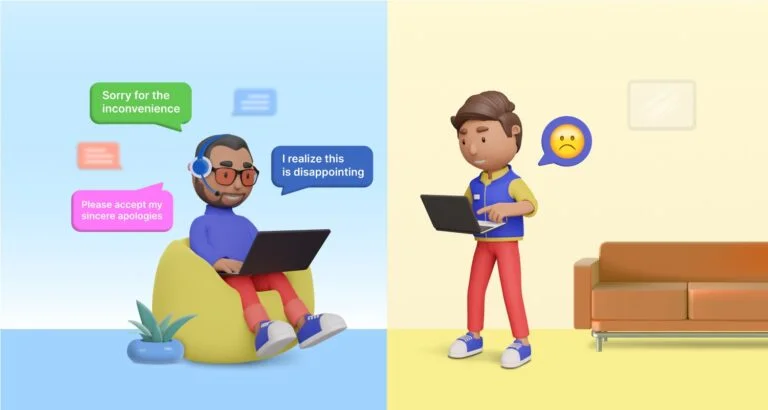
Have you ever said “sorry for the inconvenience” to an unhappy customer? It is a common response in customer service, but when used too often, it can sound generic or insincere and may do little to reduce customer churn.
A thoughtful apology can do more than acknowledge a mistake. It can show customers that you understand what went wrong, take responsibility, and are actively working to make things right.
This guide shows how to handle 10 real support scenarios with practical apology examples agents can adapt without sounding scripted.
Quick reference: What to say instead of “Sorry for the inconvenience”
What you say should change with the situation. If you are looking for a sorry for the inconvenience alternative, choose wording that reflects what actually happened.
A late reply requires a different response from a billing error or repeat technical problem.
Here is a quick reference:
| Situation | Instead of this | Try this |
| Service outage | “Sorry for the inconvenience.” | “The service is restored. Here’s what happened and what we changed.” |
| Billing error | “Apologies for any inconvenience caused.” | “We charged you twice. The duplicate charge has been reversed.” |
| Late reply | “Sorry for the delay.” | “You waited longer than our response target. We should have replied sooner.” |
| Wrong or damaged order | “We regret any inconvenience.” | “We sent the wrong item. A replacement is going out today.” |
| Repeat problem | “Sorry for the inconvenience again.” | “This issue has happened before. I’m taking ownership until it is resolved.” |
| Saying no | “Sorry, but that’s our policy.” | “I can’t approve that request, but here are the options available.” |
| Escalating | “Sorry to transfer you.” | “I’m bringing in the right specialist, and they’ll have the context from this conversation.” |
| Your team’s mistake | “Sorry for any confusion.” | “I gave you the wrong information. That was my mistake. Here’s the correct answer.” |
| Asking for details again | “Sorry to trouble you again.” | “I need one more detail to complete this: your invoice number.” |
| Closing a difficult ticket | “Sorry for the inconvenience. Closing this ticket.” | “This took longer than it should have. Here’s what we changed as a result.” |
For other common support conversations, these customer service phrases can help agents communicate clearly without falling back on stock responses.
Why “sorry for the inconvenience” can fall short
There is nothing inherently unprofessional about saying “Sorry for the inconvenience.” The problem is what happens when the phrase becomes the entire apology.
Customers do not contact support because they need to hear the word sorry. They usually need confirmation that someone understands the problem and knows what will happen next. That distinction matters.
PwC’s 2025 Customer Experience Survey found that 29% of consumers stopped using or buying from a brand because of poor customer experience.
A better apology therefore does more than sound polite. It reduces uncertainty and shows the customer that the problem is being taken seriously.
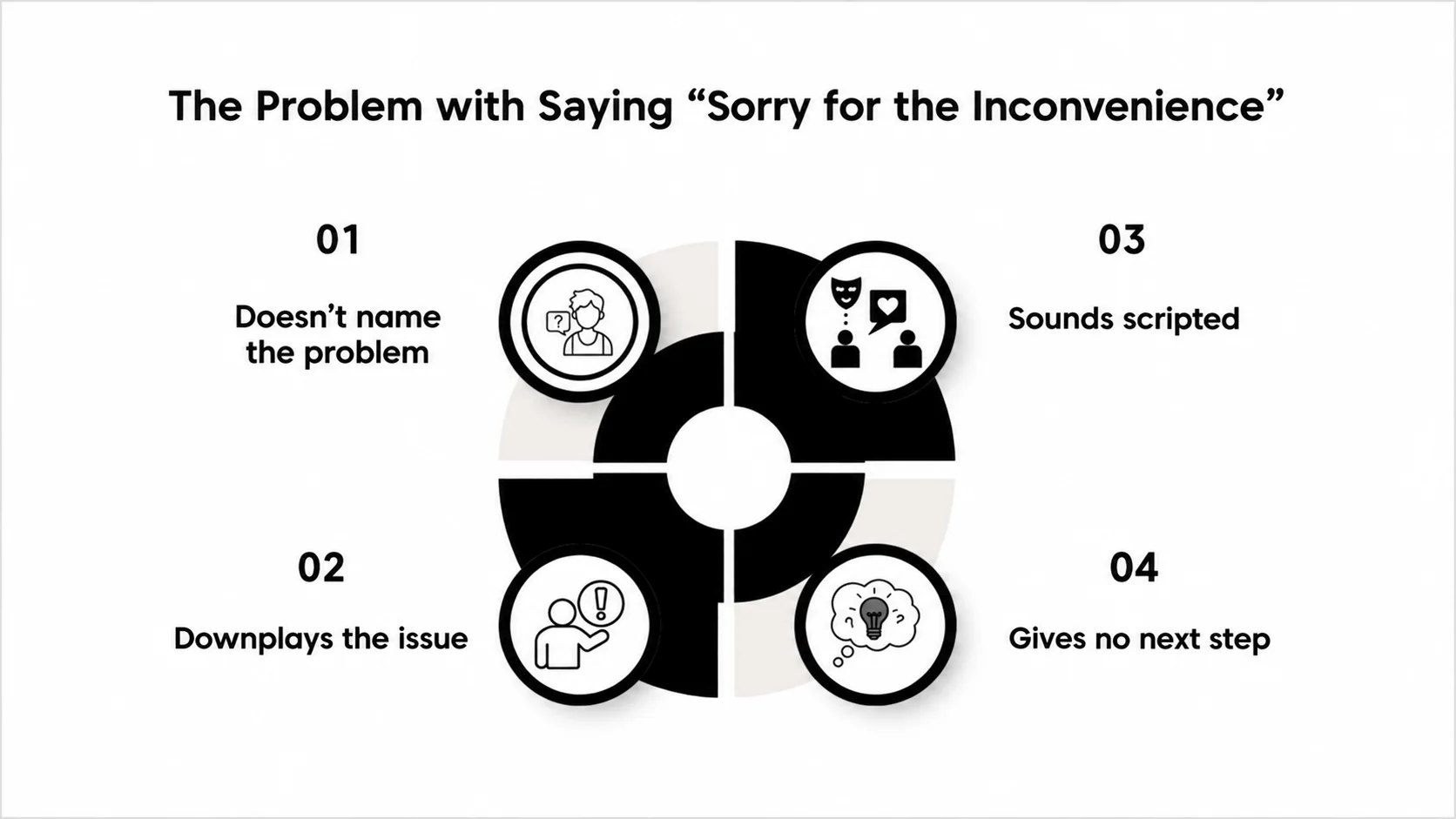
It does not name what actually happened
“Inconvenience” can describe almost anything: a two-minute delay, a duplicate charge, a missed deadline, or hours of lost work.
When you do not name the actual problem, the customer cannot tell whether you understood it.
It can make a serious problem sound smaller
Calling every problem an “inconvenience” can unintentionally minimize what the customer experienced.
A brief delay may genuinely be inconvenient. Losing access to an account during an important deadline is different.
Match the wording to the impact instead of using the same phrase for every problem. That helps support teams respond more appropriately to different customer expectations.
It can sound automated
The phrase appears frequently in autoresponders, error pages, and shipping notifications, so customers may associate it with automated messages.
When a human agent uses the same generic wording, the reply can lose the personal acknowledgment and context that makes human support valuable.
It gives customers no next step
A generic apology like “Apologies for the inconvenience” without a next step leaves the customer exactly where they started. They still do not know when the problem gets fixed or what they should do next.
“If we use ‘I’m sorry,’ what comes after that needs to be part of the apology, not a ‘too bad’ explanation.”- Shep Hyken, Customer Service Expert.
How to structure a useful customer apology
You do not need dozens of alternative apology phrases. A more practical approach is to build the response around three elements:
1. Name what happened
Be specific enough that the customer can tell you understood the issue.
Instead of: “We apologize for the inconvenience.”
Try: “Your invoice was sent to the wrong email address.”
Avoid vague substitutes such as “an issue occurred” unless you genuinely do not yet know what happened.
2. Take appropriate ownership
If your company or team caused the problem, say so clearly.
“We sent the wrong item.”
“I gave you incorrect instructions.”
“We missed our response target.”
If responsibility is still unclear, acknowledge what happened without assigning blame prematurely.
“The payment did not complete, and I’m checking where it failed.”
Ownership is not about making dramatic statements. It is about being clear about what your team knows and what it is responsible for fixing.
3. Explain what happens next
Tell the customer what happens next. A useful next step usually answers three questions:
- What will happen?
- Who will handle it?
- When should the customer expect an update or resolution?
For example: “I’ve sent the replacement today, and you’ll receive the tracking number within two hours.”
Where appropriate, you can add a fourth step: make it right. That might mean issuing a refund, replacing an item, extending a subscription, or offering another remedy appropriate to the actual loss.
For situations that need more than a short reply, these apology email templates provide useful formats to follow.
Struggling with Customer Emails? Try This—100% Free!
Enhance customer support by streamlining tickets and scaling your business. As a startup, use free software to grow your business!

10 Situations and what to say instead of “sorry for the inconvenience”
Even well-run businesses sometimes fall short of customer expectations. When that happens, a sincere apology can acknowledge the frustration, show accountability, and help move the conversation toward a resolution.
Here are 10 common support situations and clearer ways agents can respond without relying on a generic apology.
1. Service outage or downtime
When a service goes down, customers usually want to know whether it is working again, whether anything was lost, and what you are doing about the cause.
Say this:
“Our ticket portal was unavailable from 9:14 to 10:02 this morning. Service has now been restored, and your data was not affected.
We identified the cause and have changed the process that led to the interruption.”
Why it works: The response provides the current status first, then explains the problem and corrective action. That gives customers information they can act on or share with their own teams.
If the root cause is still being investigated, do not invent one to make the apology sound complete. State what you know and give the next update time instead.
2. Billing or invoice error
Money-related problems create uncertainty quickly. The customer needs to know what happened to their money and when the correction will appear.
Say this:
Why it works: It confirms the exact transaction, explains the correction, and sets a timeline.
Avoid making the customer calculate what happened from several invoices or asking them to contact another department when your team can investigate internally.
3. Late reply or missed SLA
There is little value in pretending a long wait was only a minor delay. The customer already knows how long they waited.
Say this:
Why it works: It acknowledges the difference between the service promised and the service delivered, then gets to the actual answer.
If late replies happen regularly, better wording will not solve the underlying problem. SLA reminders can help teams identify tickets approaching their response or resolution deadlines, while escalation workflows can surface overdue tickets for action.
4. Wrong, damaged, or missing order
If you sent the wrong product, the customer should not have to work harder because of your mistake.
Say this:
Why it works: It moves directly from the mistake to the resolution and removes unnecessary effort for the customer.
The exact remedy will depend on your returns policy, but the principle is the same: explain what you are doing instead of asking the customer to interpret a generic apology.
5. The same problem happens again
A repeat problem changes the conversation. The customer is no longer judging only the latest failure. They are also wondering why the previous interaction did not prevent it.
Say this:
I’ll update you every Tuesday, even if there is no new progress to report.”
Why it works: It recognizes the history of the problem and gives the customer a clear owner and update schedule.
Before responding to a repeat complaint, review previous tickets and notes. An apology loses credibility quickly if the customer has to remind the next agent what happened last time.
With BoldDesk, the contact profile gives agents visibility into a customer’s previous tickets, helping them recognize repeat issues instead of treating every request as a first-time problem.
6. When you have to say no
Support agents sometimes apologize because saying no feels uncomfortable. But surrounding a firm policy decision with repeated apologies can make the response less clear.
Say this:
Why it works: The answer is clear, the reason is explained, and the conversation moves toward available options.
Do not offer alternatives that the agent cannot actually approve. A smaller, realistic option is more useful than a generous promise that has to be withdrawn later.
7. Transferring or escalating a ticket
A transfer should move the customer closer to a resolution, not send them back to the beginning of the conversation.
Salesforce research found that 56% of customers say they often have to repeat or re-explain information to different representatives.
That makes context an important part of any escalation.
Say this:
Why it works: It tells the customer why the transfer is necessary, what the receiving agent will know, and when the customer should expect a response.
For more complex cases, AI Copilot can help agents summarize long ticket threads and attached files so the next agent can understand the issue more quickly. The receiving agent should still review the context before responding.
8. A mistake your team made
When responsibility is clear, vague phrases such as “sorry for any confusion” can make the customer feel as though the problem is being softened or shared.
Say this:
Why it works: It owns the specific mistake and shows that the fix extends beyond the individual ticket.
Where possible, use mistakes as feedback. If several agents are giving the same incorrect answer, check whether the source article, internal documentation, training, or workflow needs to change.
9. Asking the customer for information again
Sometimes another question is unavoidable. Make it easy to answer.
Say this:
Why it works: The customer knows exactly what to provide, where to find it, and why the request matters.
Before asking, check whether the information already exists in the ticket history, account details, attachments, or previous conversations. Asking twice for information you already have creates avoidable effort.
10. Closing a ticket after a poor experience
Do not treat the closing message as administrative housekeeping after a difficult case. It is your final chance to show what the team learned and what the customer can expect if the problem returns.
Say this:
“This took nine days to resolve, which is longer than it should have. The delay happened during a handoff between two teams, and we’ve changed how those handoffs are tracked.
Thank you for staying with us while we worked through it. If the problem returns, reply to this ticket and we’ll pick it up from there.”
Why it works: It acknowledges the experience without dwelling on it, explains what changed, and leaves the customer with a clear path back to support.
Clear follow-up and visible corrective action can also help rebuild customer trust after a poor support experience.
For serious failures where an apology is only one part of rebuilding the relationship, use a structured service recovery process that addresses both the immediate issue and the cause behind it.
Make good apology responses easy to reuse
Writing a thoughtful response is easier when the queue is quiet. The challenge is maintaining the same standard when agents are handling many conversations at once.
Reusable responses can help, but they should provide a starting point rather than a message that gets sent unchanged.
BoldDesk supports canned responses that agents can manually insert into ticket replies and edit before sending.
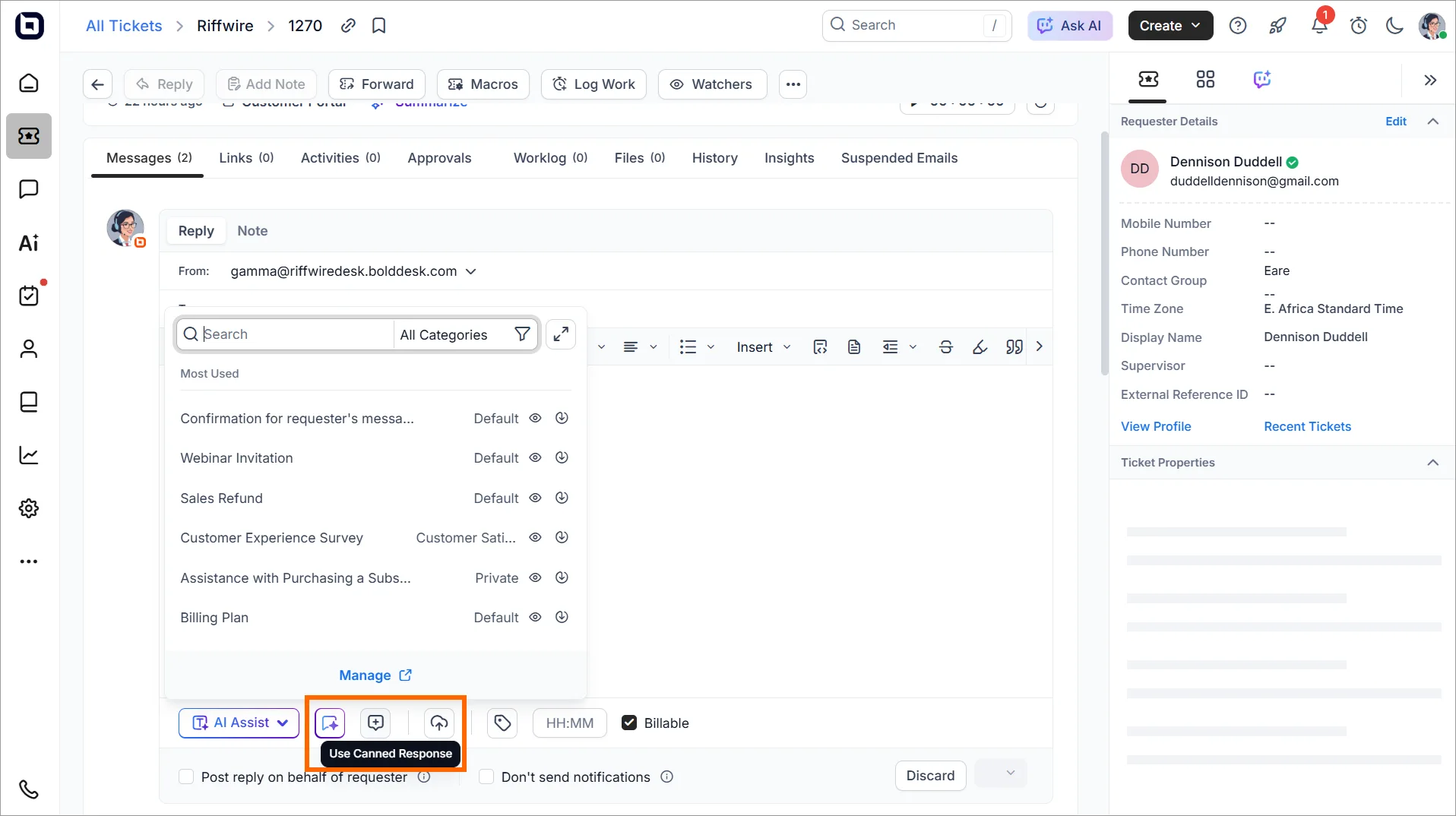
A few practices make reusable apology messages more effective:
- Build them around situations, not generic apologies. Create separate responses for billing problems, delays, outages, handoffs, and other recurring issues.
- Leave room for the facts that matter. Agents should be able to add the customer’s specific problem, resolution, and timeline.
- Review them after real tickets. If agents repeatedly rewrite the same template because it does not fit customer conversations, update the saved version.
- Retire responses that no longer match your policies. Old refund periods, shipping timelines, escalation instructions, or product details can turn a helpful template into misinformation.
For less predictable situations, AI-assisted drafting can help agents create a response around the context of the ticket while keeping a person in control of what is sent.
If your team is building a response library, these canned response examples provide a useful starting point for common support conversations.
Situations when a better apology may not fix the problem
If your team keeps apologizing for the same problem, the wording may no longer be the issue.
Look for patterns such as:
- The same complaint appearing repeatedly across tickets;
- Apologies clustering around one feature, integration, or billing process;
- Customers repeatedly contacting support because an earlier fix did not hold;
- Agents apologizing for slow responses caused by persistent queue backlogs;
- Frequent transfers between the same teams.
Those patterns should trigger an operational question: What is repeatedly creating the need to apologize?
A product defect belongs with the product or engineering team. Confusing documentation may require a knowledge base update.
Recurring delays may indicate a staffing, prioritization, SLA, or routing issue within your help desk software.
Track the reason behind apologies, not merely how often agents use the word sorry. The reason gives you something the organization can fix.
Turn thoughtful apologies into stronger customer experiences
“Sorry for the inconvenience” is not always the wrong phrase. The problem is using it when the situation needs something more specific.
A stronger response acknowledges what happened, takes responsibility where appropriate, and explains what happens next. If the same apology keeps appearing, look at the underlying process, routing, documentation, or product issue causing it.
BoldDesk brings customer conversations, reusable replies, ticket history, and support workflows together so agents can respond consistently with the right context.
Sign up for a 15-day free trial today to help your support team respond faster, stay consistent, and handle customer issues with the right context. No credit card is required.
Recommended reads
- 12 Customer Service Scenarios: Role-Play Examples and Tips
- How to Deal with Angry Customers: Tips and Templates
- 50 Customer Service Email Templates for Fast, Consistent Responses
Frequently Asked Questions
Yes. “Sorry for the inconvenience” is professional and grammatically correct, but it can sound generic when used alone. For significant problems, acknowledge what happened and explain the next step rather than relying only on the phrase.
Acknowledge the specific problem, take responsibility where appropriate, and explain what happens next. For example: “Your order arrived two days late. We’ve refunded the delivery fee, and your replacement will arrive tomorrow.”
Be specific and solution focused. For example: “We recognize the delay this caused. Your request is now with our billing team, and you’ll receive an update by 3 p.m.” You can still say sorry but pair it with clear action.
Acknowledge the problem and explain what you are doing next. For example: “You’re right. This should have been resolved during your first contact. I’ve taken ownership of the case and will update you by the end of the day.”
Acknowledge what happened, recognize its impact, take responsibility where appropriate, and provide a clear next step.
Avoid vague apologies or promises you cannot guarantee. Instead, explain what you are doing to resolve the issue and when the customer can expect an update.
State when the outage occurred, whether service is restored, what was affected, and the confirmed cause if known.
Explain what action is being taken and when customers can expect another update. Avoid speculating while the cause is still under investigation.
Describe the specific problem instead of relying on another generic phrase. For example: “You had to submit the form twice because our first upload failed. We now have both documents, and you do not need to send anything again.”